

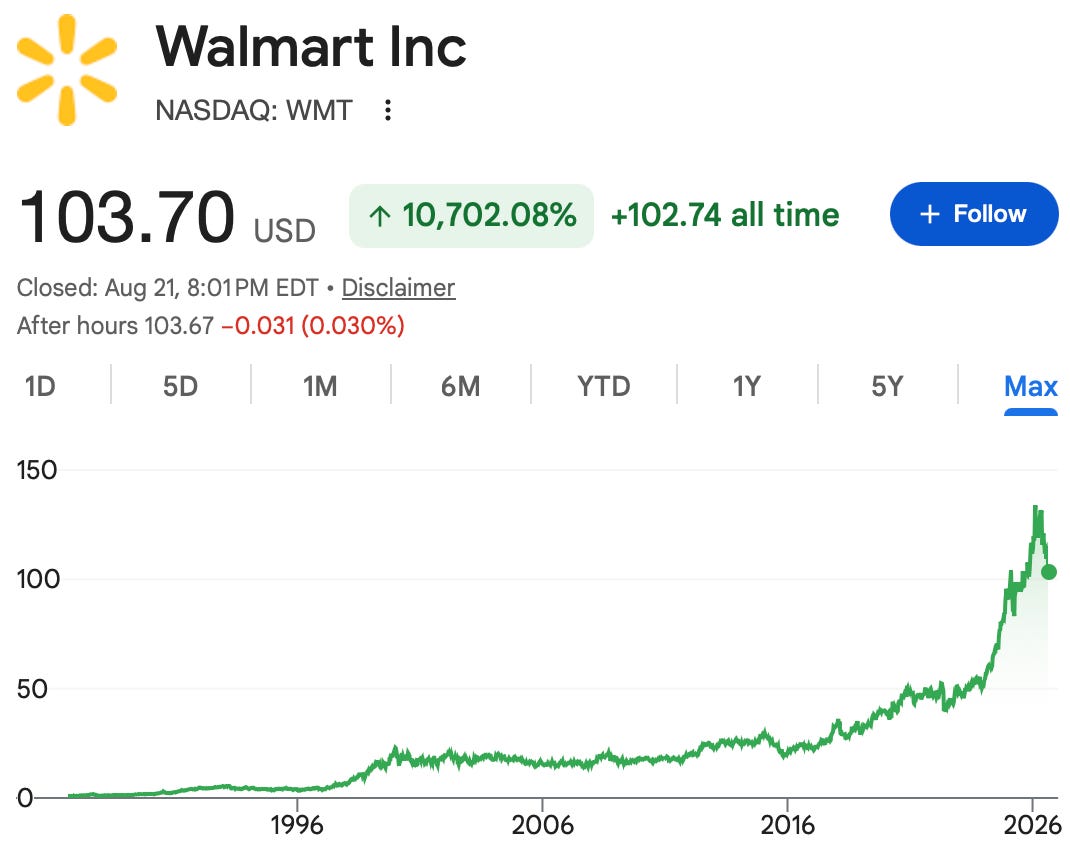
Walmart, the world’s largest retailer with $736 billion in sales and 2.1 million employees (slightly more than the populations of Idaho and Nebraska), closed about 9% lower on Thursday after U.S. comparable sales growth slowed to 2.6% — the lowest in over six years. Shares now trade at 38x trailing earnings.
Over the past decade, store count declined from 11,695 to 10,955 while earnings per share grew at a 6% compound annual rate. Walmart remains a solid business, generating roughly 12% pretax returns on tangible assets (operating income divided by tangible assets, excluding cash).
It cannot, however, reinvest all of its capital at those rates. Last year’s operating cash flow was $41.6 billion. Of that, $26.6 billion was reinvested in the business in pursuit of another 12% pretax return (about 9% after-tax at a 25% effective tax rate). The remaining $15 billion was returned to shareholders through share repurchases and dividends in roughly equal amounts.
If Walmart sustains its competitive advantage over the years, the 64% of cash flow reinvested should support 6% annual EPS growth. At the current price and pace, buybacks and dividends each contribute roughly 1%, for a prospective total return of about 8% — assuming the earnings multiple holds at 38x.
If the market instead awards Walmart a 16x earnings multiple a decade from now— in line with the S&P 500’s long-term median — the stock would face an 8% annual headwind from multiple compression. Buying shares at the current price would likely produce flat nominal returns by 2036.
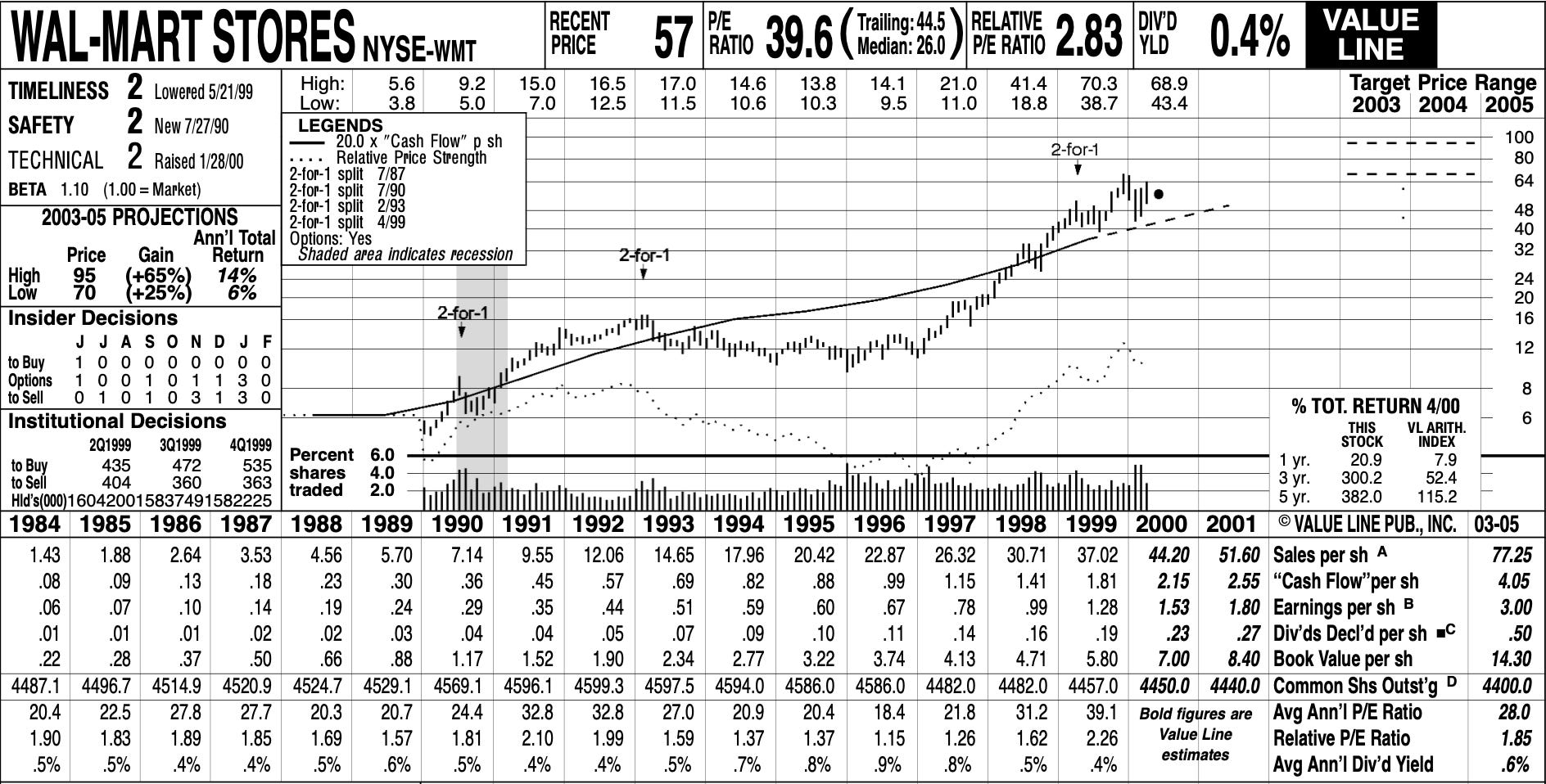
In May 2000, WMT traded at 44.5 trailing earnings. EPS had compounded at 18% over the last decade. Supercenters were on a roll and the international business was booming. ValueLine figures below.
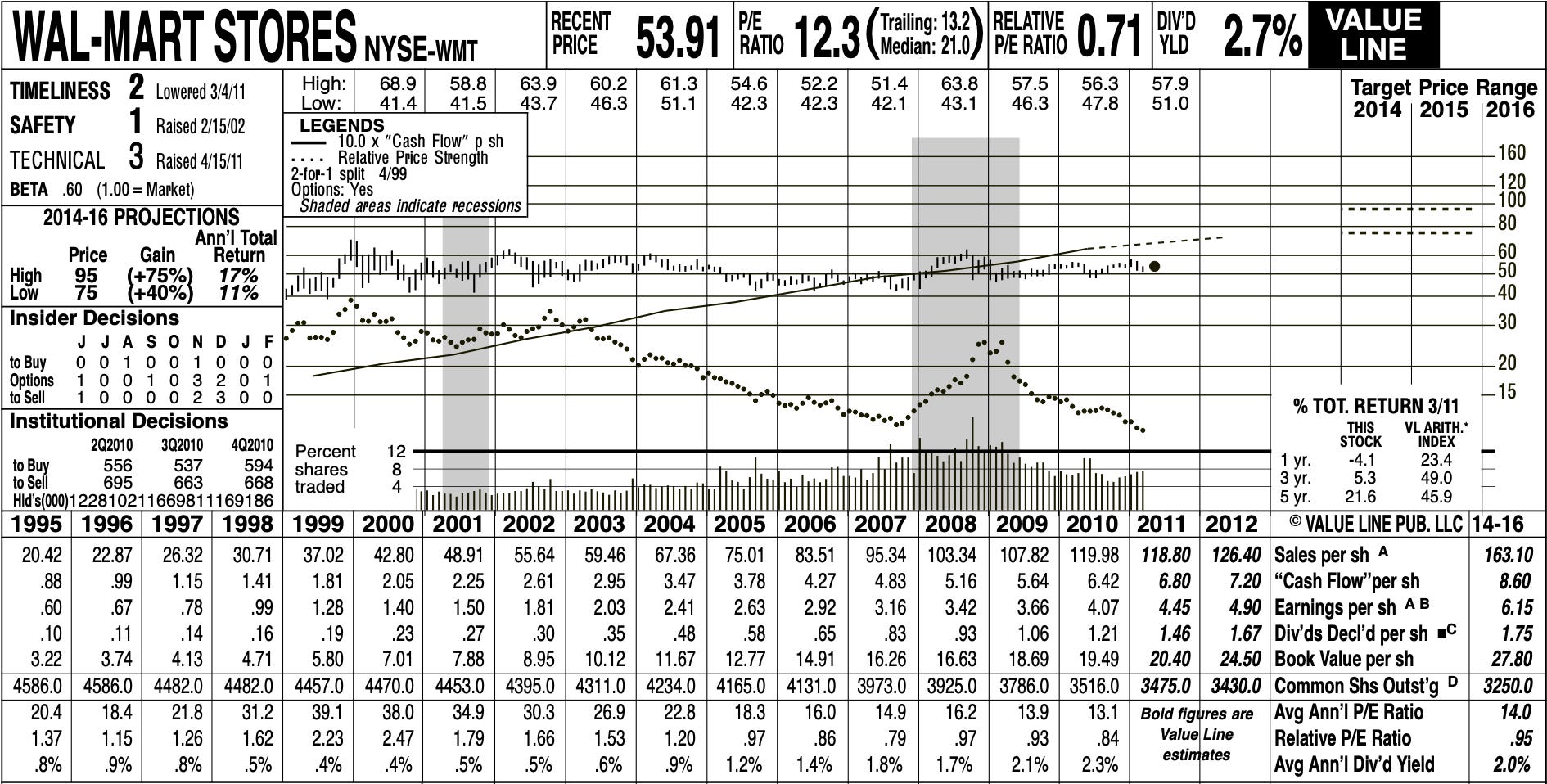
In May 2010, Walmart traded at $54 even though EPS had compounded at 12% annually since May 2000. Over those ten years the earnings multiple compressed from 44.5x to 13.1x, imposing an 11.5% annual drag that left the stock essentially flat.
Shareholders earned an annual total return of just 1.8% per year (dividends reinvested), compared with 6.1% on the 10-year Treasury note. After inflation, Walmart shares declined 0.6% annually — an erosion of roughly 5.9% in real principal.
Walmart is a good short candidate. The stock is trading at dot-com valuations but doesn’t have the same growth engine. The market cap is $825 billion but its probably worth around $250 billion. Short interest is 1.7% and the borrow rate on shares is 0.41%.
Shorts stay away because WMT has historically been an amazing compounder and a bellwether of the consumer defensive sector. In soft consumer environments it often acts as a relative safe haven. During the global financial crisis, WMT grew earnings per share at a 7.6% rate.
WMT returns in recent bear markets:
2022 = (0.46%) — 2021 average trailing P/E = 21.9x
2020 = 23.32% — 2019 average trailing P/E = 22.3x
2008 = 20.00% — 2007 average trailing P/E = 14.9x
2000 = (22.78%) — 1999 average trailing P/E = 39.1x
From 2000 through 2002, WMT fell about 26% (maximum drawdown of 37% in October 2000) while earnings per share continued compounding at 12.2%. Today the stock trades at a similar multiple of earnings as it did during the dot-com bubble, yet growth is about half of what it was then.
Odds of the stock gaining another 50% or 100% in the near to medium term seem low. Consumers are struggling and inflation could stay elevated for some time. Margins are much more likely to contract than expand and any sustained squeeze would probably cut the multiple in half. Walmart is a very risky stock.
Very good write up. Enjoyed reading it.
Great post. A fantastic example of how important valuation and price are!