
Peter Lynch Interview
“I think the best stocks I had, I think if 100 people did work on it, 99 would say that’s better than I expected”. – Peter Lynch

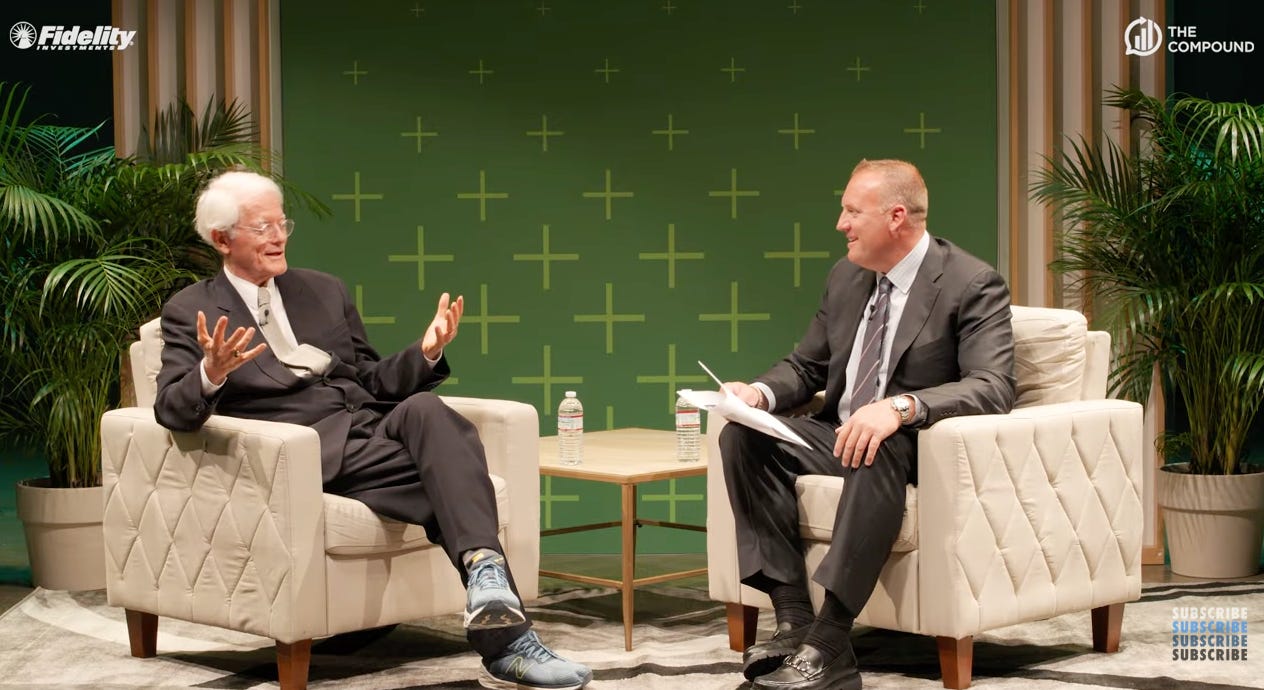
Last week, Josh Brown interviewed Peter Lynch. Below is a transcript.
Josh Brown: All right, this is such an incredible treat. I was told, I don’t know if you heard this, the last people to sit in these chairs uh was Oprah Winfrey. So, uh if anyone finds a set of keys to a new car under your seat, that’s not from us. That’s from a prior uh event. Ladies and gentlemen, this is one of the honors of my career. I’ve been excited about this for weeks. Um Peter needs no introduction, of course, in this room, but I’m going to give him one anyway. He asked me not to do a long introduction so that uh we don’t embarrass him, but um I have a couple I got a couple of things I got to say. Is that okay?
Peter Lynch: Sure. Please.
Josh Brown: All right. All right. Peter is vice chairman of Fidelity Management and Research, the investment advisory firm of Fidelity Investments, where he has worked since 1969. He is also president and chairman of the Lynch Foundation, which supports programs that focus on education, cultural, and historic preservation, health care, and medical research. From 1974 to 1977, Peter was director of research at Fidelity. And from 1977 until his retirement in 1990, he was manager of the Magellan Fund at Fidelity. During his tenure at the Magellan Fund, Peter averaged a 29.2% annual return, consistently. (loud applause from crowd) That’s right. That’s right. Consistently more than doubling the S&P 500 market index, making it one of the best perform uh the best performing mutual funds in the world and the best 20-year return of any mutual fund ever. During that time, Magellan’s assets under management increased from $18 million to $14 billion. Ladies and gentlemen, Peter Lynch. All right. Um, anything you want to get off your chest before I start?
Peter Lynch: Roll. Let’s roll.
Josh Brown: All right. Uh, there are a lot of reasons why you’re on the Mount Rushmore of the greatest investors of all time. One of them is obviously your track record. Another is how much wisdom you were willing to share with everyone else via uh books and interviews which back then was very rare. Um but among your greatest achievements is the fact that you went out on top literally at the height of your popularity and your performance in 1990. That was 35 years ago. You were 46 years old at the time. And I wanted to start by asking you about that decision.
Peter Lynch: Well, I love the firm. I still love the firm. It’s the best ever put together. And uh my father died at 46 and I was 46. I remember that number. And I was in the office every Saturday 7:00. We said we get up for a basketball game on Saturday. And in Wellington they couldn’t play double solitire, you know. So uh every day I enjoyed it. People were fantastic. I just we had three daughters and I just wanted to spend more time with my wife and the third daughter. So, and I was lucky enough to finally said just stay on. We’ll give you a role here with working with young analysts and fund managers. So, it’s been great. Great company. The best.
Josh Brown: Did you ever think about getting back into the game? Was there ever a moment or a temptation where you said, “You know what? I think I want to. I think I could do this better than everyone else out there still, and I want to, I want to go for it.”
Peter Lynch: I had all these offers to do a close-end fund. Okay. 1 billion, two billion, 2% fees. The market’s up thirty fold.
Josh Brown: Yeah.
Peter Lynch: Thirty fold since I left. Okay. So, if I just did average, it’d be a $60 billion fund.
Josh Brown: Yeah. The temptation was never great enough though.
Peter Lynch: No, no. I’d have to, I’d still be working those same hours, because one out of every hundred Americans was in the Magellan fund.
Josh Brown: Is that right?
Peter Lynch: One of every hundred Americans was in the Magellan fund. These are people that $5,000, $10,000 was very meaningful.
Josh Brown: Did the weight of that uh get to you at all while you were running the fund? The level of responsibility?
Peter Lynch: Yeah, yeah. I had a perfect record. I think the market went down 10 times those 1 years. Okay. I went down more every time than the market. Every time.
Josh Brown: Okay. Um but you somehow managed to get through those moments when you were down. How did you do that?
Peter Lynch: In ‘ 87. I got letters from people saying, “Hang in there. It’ll be great. Don’t worry about it.” You know, it was amazing.
Josh Brown: Um, I wanted to ask you if there were ever moments where you looked at something that was happening in the market, whether it was a bull market or a bear market, and said to yourself, if I were at Magellan, I know exactly what I would be doing right now with this opportunity. Have you had those moments?
Peter Lynch: Yeah, I did have that moment when uh Pets.com came public and pets.com. I said, “What? This makes no sense at all.” And then went up, so I can’t short. So, but there was so many companies of no value. Yeah. And fortunately, Fidelity didn’t own those damn things. So, that was a period to say, “Wow, what’s wrong here?” You know?
Josh Brown: Okay. Um, I wanted to ask you who are the professional investors or the corporate leaders or other people on Wall Street that you either admire most today or that you looked at and and learned from during your tenure managing who are your heroes or who are your mentors?
Peter Lynch: I’d say Lee Lacocca would be really up there at Chrysler, Ford and Chrysler and then Bob Walter at the
Josh Brown: Well, let’s let’s pause. Lee Lacocca. What was it about him that you admired?
Peter Lynch: Well, imagine, imagine the Thunderbird at at the Mustang at Ford. Then he brings in the minivan and Jeep at Chrysler. Incredible. It’s just a wonderful person. And then you know this Bob Walter when Cardinal was buying supermarkets had a 37 million value when it came public. It’s now 37 billion. This guy Bob Walter I mean so good. And uh I’m trying to think of another. There’s so many great entrepreneurs that aren’t that well known that I think it’s Al Namad. He’s at uh it’s an amazing company in Florida. That’s up 100 fold or Ben Camarada. TJ Maxx. TJ Maxx is up 100 fold. That’s Ben Camarada. I mean those are great people.
Josh Brown: One of the things that you’ve talked about is your
Peter Lynch: Watsco, Albert Nahmad.
Josh Brown: One of the things you’ve talked about is your early introduction to Wall Street. There was a lot of disbelief about the stock market in the house you grew up in, but then you got your first job caddying on the golf course and all you heard was how much money people were making. Tell us a little bit about that time in your life.
Peter Lynch: Well, actually, you know, people, you know, if you grew up in the 40s, you heard about the big one, the depression. Yeah. There’s one coming. What do you think? Risk averse. It was risk averse. And uh but I was a caddy and uh people would talk about what stocks they’re buying. I’d look it up and a few months later they were higher. Yeah. This pretty good deal, you know. So, I didn’t have money, but I had to talk about their shots, but it was a great role of a caddy because you’re like an adviser to somebody. Just tell them, you know, if you miss a screen, don’t miss it to the right or don’t be short or line of putts. It’s incredible. My friends were delivering newspapers at 5:00 a.m. I was making more on Saturdays than making the whole week. So, and the president was Mr. Johnson was the CEO and Djour Sullivan was the president and I caddy for him. They said, “Gee, why don’t you interview for a job at Fidelity?”
Josh Brown: How old were you when that offer came?
Peter Lynch: 21. So, summer of 66, I was somehow the only one to caddy for the president. So, I got the job. There’s like, I think there were 75 applicants for three spots, but I got the spot in ‘ 66. And uh so then I had to do one more year of war and two years in the army. Came back in ‘ 69. So I owe it all to being a caddy.
Josh Brown: What uh, what did you have to do at Fidelity to pay your dues to the point where they were willing to give you money to invest for other people?
Peter Lynch: Yeah, I think they forgot all my mistakes because I had the uh I had the textile the worst groups the textile stocks, the steel stocks, the metal stocks. I don’t know how we ever survived that, there weren’t many winners ever.
Josh Brown: They gave you the stocks to cover that nobody else cared about.
Peter Lynch: Well, everybody had groups. Somebody did retailers, somebody did electronics, somebody did oil, somebody did truckers, somebody did railroads. I wound up with the drags.
Josh Brown: I wanted to ask you what were some of the traits in the investors that you were learning from or the people that you admired in money management? What were some of the qualities in those people or their habits that probably still resonate for investors today?
Peter Lynch: When I started with this person Allan Gray, he he went back to South Africa about 10 years later, but he would work hard. He’d research companies. He’d listen to my stories. He was probably the best role model. I remember Alan Gray. Okay. And my peers were all great. I mean, all the people around me, everybody in the research was really talented. So, we’re loaded with skill. It’s funny.
Josh Brown: I interviewed one of your colleagues yesterday. She’s a quantitative analyst at Fidelity. And it’s so funny to hear you say that because she said the exact same thing. She said, “Any question I have about markets or the economy, this whole building is filled with talented people who know what’s going on, and all I have to do is walk down the hall and get the answer to my question.” You still feel that way about the organization today?
Peter Lynch: It’s unbelievable. I mean, Steve Wymer, John McDow, Joel Tillyas, Will Danoff. I mean, you know, like the the Yankees were, you know, in the 1920s, and we’re playing the Yankees right now.
Josh Brown: I won’t, I won’t tell you who I’m rooting for. So, I thought it would be funny to take some of your legendary quotes and witisms. Um, they’ve all been attributed to you. You’ll tell me if they’re not actually you, but um these have been taken from interviews you’ve given over the years, from the books that you’ve written, from the things that you’ve you’ve written and and and published. I thought it’d be fun to share some of these with the audience. The audience probably can quote some of these by heart uh and just have you react to them and tell and tell us uh where it came from or what the lesson is behind the thing that you were trying to get across. Um, I’ve got a couple of categories for these quotes. I kind of did a little taxonomy. So, the first category involves the risk of investing in stocks. And you said the real key to making money in stocks is not to get scared out of them. Why is that the key to making money in stocks?
Peter Lynch: Well, more important to that is I have this expression, know what you own.
Josh Brown: I was going to do that one later. I’ll cross it off.
Peter Lynch: But that’s, most that’s it. That’s the most important lesson. Because you’ll get shaken out if the stock goes from 10 to 8. You don’t know what they’re doing. What are you going to do with it? And uh I was telling you earlier, I got a call. I did an ad for Fidelity with Lily Tomlin. She’s very close to Barbara Streisand. So I’m on vacation, my wife and two other couples, and my secretary Paul says, “Barbara Streisand’s called three times. She’d really like to talk to you.” And she’s very nice. And you know, I said, “Sure, I got some time.” So, I called him and she said, “I own all these stocks and I’m getting up at 5:00 a.m. to look at this stuff.” And he says, “I” she said, “I never did drugs. I never did marijuana. I just can’t sleep. What do I do?” I says, “Tell me five things you own.” She named five companies. I say, “Okay, what did they do?” She didn’t have any idea. Here’s an incredibly talented person. She had no idea what those companies did. So, what are you going to do if they go down 50%? If you don’t understand what you own, you’re toast.
Josh Brown: It sounds so obvious to hear you say it, but it’s amazing. Uh you talk about people spend more time researching a refrigerator they’re going to buy than they do a stock they’re going to invest part of their life savings.
Peter Lynch: People are very careful. They spend hours, and get 50 bucks off on an airplane flight. They look at everything, and they put $10,000 in some crazy stock they heard on the bus, you know, and uh you know, and they have no idea what they’re doing. And somebody invented this awful term before I got in the business called play the market. Play the market. You don’t like that term. That is sometimes a noun, there’s a verb. It’s a very dangerous verb. Play the market is not what you do. You buy good companies and some work and you have to know what they do. There was this farm in western Massachusetts, the two companies, Tampax out there. Friendly ice cream. He put $1,000 in a month for 10 years. Brilliant idea. He says if they stop hiring, I’m going to leave. Okay. You made a million dollars. I mean, people have all these edges. People in the steel industry know it’s getting better before I do. These people have an edge and they might as well go to a casino and bet on red, you know.
Josh Brown: So, by knowing the companies that you’re invested in, there’s a higher likelihood that you’ll be able to stick with them when other people are scared.
Peter Lynch: Yeah. The average range for a stock on the New York Stock Exchange, the average high, average low every year is 100%. The stock might start at 20, sell at 28, finish at 14, finish at 20. There’s a 100% move every year.
Josh Brown: So, it’s 50% up, 50% downish. And that’s how it’s 100% swing in the price.
Peter Lynch: That’s the average stock. And most stocks you’re going to buy, they’re probably going to go down. The odds sometimes, they go up. If the story is powerful, like Watsco or Chrysler, you might buy it up. If you don’t know what they do and it goes down, and I’ve had people say, “This stock’s gone from 50 to one. How much can I lose?” And I say, “Well, wait a second. If somebody put $10,000 in at 50 and you put $50,000 at one, if it goes to zero, who loses the most? I mean, stocks go to zero? I’ve had them. You know, I wasn’t buying them on the way to zero, but stocks go down. If you don’t understand what they do, if you can’t explain to an 11year-old in a minute or less why you own it, not this sucker is going up. I’ve heard that one before. Why? What is the story of this company? They have good business, good balance sheet, they’re fine. That’s why I own it. If you can’t do that, you should buy a fund.
Josh Brown: You’ve instructed investors to write a script for the stock they’re going to buy. Write the story down. Why is the stock going to work or why is it undervalued?
Peter Lynch: Because I’ve told this to people in high school and college saying, make a paper portfolio. Yeah. Pick 10 stocks and watch them over a year or two and say why you bought them. List the reasons and see what happens. That’s what this we’re about. We do this. We have those our fund managers. They don’t wait for the analysts to come in. They’re out researching companies. They’re on the phone talking to companies. Every fund manager is the highest role is an analyst, fundraiser analyst. We have analysts under that. We have all this information coming in. It’s staggering now, information. I could go back in time. We own a lot of Nike. This story is amazing. I own a lot of Nike and their inventories were out of whack. Not a good sign. This before the internet. We had to go to a library and get their quarterly report. Our library. We got to come in, we opened up, inventories went down. We backed up the truck. I mean, the concept of, you know, they used to mail it out by mail to the shareholders. Now they have a website. It’s everybody on the planet knows what they do. Yeah. Information is unbelievable. If you can’t understand, they have company presentations. It’s a lot easier to understand what you own today.
Josh Brown: So I think you’re saying in today’s day and age, you have no excuse not to know the companies you own. It’s too easy. It’s too easy.
Peter Lynch: You don’t need a Bloomberg. It’s websites.
Josh Brown: Here’s another one on risk. You said far more money has been lost by investors preparing for corrections or trying to anticipate corrections than has been lost in corrections themselves. Talk about that.
Peter Lynch: Well, I think people, you know, they’re always worried the market’s going to run and and it does, as I mentioned. Um, and you know, two years ago they were saying 2024 was going to be a down year for the economy and 25 has been a down year. I mean, every year I think economists predicted 33 of the last 11 recessions.
Josh Brown: And with great certainty in my head.
Peter Lynch: Yeah. Yep. And I think, you know, people are they’re basically it’s a you look dumb in this business. You’re terrific in this business. If you write six and a half times out of 10, that’s a great score. Yeah. Even if you’re right five times out of 10, if you own Costco or Walmart or or I can’t pronounce in the video. I’m getting close to being able to pronounce it.
Josh Brown: I think you, I think you nailed it just there.
Peter Lynch: Yeah, that offsets your mistakes. Yeah, you have to have these winners offset
mistakes. And that’s what we’ve done for 70 years at Fidelity.
Josh Brown: So, you’ve got two more on this topic. I’ll read them both. Um, you said you get recessions, you have stock market declines. If you don’t understand that’s going to happen, then you’re not ready. You won’t do well in markets. You also said people who succeed in the stock market also accept periodic losses, setbacks, and unexpected occurrences. How important is it for the average, I hate the term average investor, for the typical investor to go into this business understanding there’s no way to dance around these things. They’re going to take place. You’re going to have to live through them. Would you say that’s paramount? Because that’s what I think.
Peter Lynch: Well, the point is, what if somebody has three children about to start college in two years? They shouldn’t be in the stock market. That’s right. They should be in the money market fund. But it depends if you got your house, paid down your mortgage, then you can invest and it’s been a great place to be since, you know, 1900.
Josh Brown: Yeah. Um, one of the more timeless things that you’ve said, and it comes off as sarcastic, but I think the last 15 years have really uh, proven the value of this idea. Um, coming out of the great financial crisis, the most in vogue style of investing was macroeconomic uh, hedge funds because there were a small handful of people who determined that the housing crisis would ultimately bring about a recession. And those people were revered for a couple of years. Um, you’ve never really been big on trying to outguess everyone else on the economy. And you said if you spend more than 13 minutes analyzing economic and market forecasts, you’ve wasted 10 minutes. I still quote you uh to this day when clients call up and they want to talk about the latest labor report or what the Fed’s going to do. Tell us how long did it take you to figure that out and how much push back did you get when you said it from people that were economists or focused on the macro?
Peter Lynch: Well, I I don’t remember if I ever have an economist. So, we just buy stocks and she’s uh she’s here tonight. So, I’d love to get next year’s Wall Street Journal. Yeah, I will pay at least $5 for next year’s Wall Street Journal. Know that. And hands off to the people did the big short. I had no idea how bad the housing market was, how bad people had second mortgages. They had home improvement loans. They were underwater in their house. I had no idea. Hats off to them. But uh and but I look at facts like what’s happened to debt, credit card debt, what’s you can get that now. What’s happened to the savings rate? What’s happened to employment? I’d love to know what’s happening in the future. I’ve been hoping I could get that in the last 81 years. It’s not available. So I just deal with what’s now. What’s happened to used car prices? What’s happening to the price of oil? You know what you know and you look at industries that have gone from miserable to getting better like Chrysler. I mean I remember people says gee you were really good on that show but how could you possibly recommend Chrysler? You know that it’s gone bankrupt. You know, well, they had 2 billion in cash and they had enough money for the next three years. They weren’t going bankrupt. But, you know, so I think the best stocks I had, I think if 100 people did work on it, 99 would say that’s better than I expected. So, I use this for one of our great fun Joel Tillingast. I wrote a forward to his book and uh always said the person that wins the most turns of the most rocks wins the game. And I said, Joel Sing is a great geologist because if you look at 10 stocks, you probably find one that’s mispriced. Yeah. Look at 20, you’ll find two. Look at 40, you’ll find four. And that’s what we’ve been doing at Fidelity. We just don’t look, we look at everything.
Josh Brown: Yeah. So, you’re not discounting the value of economic data.
Peter Lynch: Oh it’d be great.
Josh Brown: You’re you’re you’re saying if it’s not from the future, the market already understands this.
Peter Lynch: Yeah. I mean that I just want to know facts right now. Yeah, that’s, that’s important.
Josh Brown: You said behind every stock is a company. Find out what it’s doing. Some of the great stories about your big investment success involve hands-on observations that you had been able to make living your real life, being in a supermarket, being in a shopping mall, looking at what people are doing. I think that over the years that idea has kind of been mischaracterized as if you use the product it’s automatically a good stock which is not what you meant at all. Could you explain the difference between those two ideas and why that’s so important?
Peter Lynch: Well, a lot of people I met so many nice people earlier tonight and a lot of them had read my book one up on Wall Street and I had the story about I had a great investment. My largest position was in Hanes that had these pantyhose called legs. They weren’t that sheer. They really fit. But most pantyhose are being sold in fancy department stores. This was at the supermarkets. Yeah. And people go to a supermarket once a week. They go to a fancy store once every couple months. My wife went a little more often, but uh the uh and I went with her. the uh so this was an incredible success, incredible success. But then a larger company called Kaiser Roth put the thing right next to it and it was called nononsense pantyhose. So I went to two different stores, about 65 different pairs of nononsense pantyhose.
Josh Brown: Now what kind of look did you get from the clerk in the process of that activity?
Peter Lynch: Yeah, it was an odd purchase, but uh I spread it over three stores, but the uh but I gave it out to everybody at Fidelity, and said give me some feedback on this. They said it’s not that good. It’s not that good. Okay. So, and the other one the other one the first stock I bought at in Megallen was Taco Bell, and I had to say I had to say, I own this myself. Is it okay?
Josh Brown: Who was clapping for Taco Bell? It’s not one of my people, was it? Okay.
Peter Lynch: And uh so I said, “Can I buy some stock that I own myself?” Said, “Sure.” You just can’t sell it after you buy it. You have to hold on. So, that’s when we had Ma Bell and all these Bell companies. And so I called the trade room. I said, “I want to buy Taco Bell.” They said, “What is Taco Bell?” And I explained what a taco was. They’re only in Southern California. They’re going to central California. I didn’t get a burrito Supreme, but I will explain a taco because it’s basically a taco that has very little meat, a lot of protein. You can sell a really good meal for a low price. And I got robbed on it because Pepsicola bought Pizza Hut and they bought some Kentucky by Chicken. They bought Taco to sell Pepsi, right? This stock would have gone to 500. Yeah. My largest position was 18. They bought at 30. Okay. Would have gone to 500, 600. But they bought it to sell Pepsi.
Josh Brown: When Chipotle came along, did you avail yourself of the opportunity?
Peter Lynch: I did. I did. But how do I miss Starbucks? I don’t get that. You know, cuz I own Dunkin Donuts. How did I miss Starbucks? I mean, you missed Starbucks. Brain cramp. I didn’t buy it.
Josh Brown: Well, okay. Um, you’ve got some great quotes about portfolio management, and here are a few of them. You said, “In the long run, a portfolio of well-chosen stocks and or mutual funds can outperform the most sophisticated investment strategy.” I think there’s a cottage industry today and probably there has been for a long time of people selling complexity to investors, right? It’s one of the best sellers on Wall Street. Um just that simple statement I think uh very much is something that most of us would associate with Fidelity and very much is something that we would associate with you. Why do people need to hear that message today?
Peter Lynch: What’s funny earlier on I met maybe hundred people to chat with them, and somebody’s in the audience they they shovel chicken poop, and they use the word Ronzohit. Who’s, is there a person here with the chicken poop in New Jersey?
Josh Brown: Waving at the top you won’t be able to see. Congrats.
Peter Lynch: But but he he decided to be a serious investor do hard work he said he’s done extremely well.
Josh Brown: Yeah. So, do you think that that’s still possible today given how armed to the teeth professional investors are with data and tools and high frequency access? Is it still possible to be someone who just on a part-time basis when they get home from work reads about stocks and makes decisions? You still believe in that?
Peter Lynch: Well, I’ll tell you a story personally. My daughters got me an iPod. This before the iPhone. Yep. And the PC business was terrible. They’re selling for 80 or 900 bucks, making $20. They had a decent balance sheet. The iPod was $200. They make 150 on it. Yeah. The iPod financed the iPhone. No, it just did some work. And the company had 300 million in cash.
Josh Brown: This is Apple in 2001ish.
Peter Lynch: I’m not sure. But it, you know, things change. Companies are dynamic. Something comes along and things go from terrible or we use a term or appropriate crappy to semi crappy to better to terrific. Something happened at Apple and they were now going to make a lot of money. I had no idea. I have a phone on me, an iPhone, but I had no idea what’s falling. The stock easily was a triple just on that alone.
Josh Brown: Um, this is one of your more famous quotes and made famous by being uh requoted by Warren Buffett. You said, “Selling your winners and holding your losers is like cutting the flowers and watering the weeds.” That’s a great one. That’s an all time.
Peter Lynch: Yeah.
Josh Brown: Um, you were known to hold on to winners for a very long period of time. A lot of people were quick to take profits so they could say, “I won.”
Peter Lynch: Yep. Yep.
Josh Brown: Um, tell us the Warren Buffett connection to that quote and why it’s meaningful.
Peter Lynch: I don’t know how I got my landline, but I got this call. Annie, I think it was like seven, our middle daughter says there’s a Warren Buffett on the phone here. You know, I thought
Josh Brown: What year do you think this is? If you could remember. Well, what era is this?
Peter Lynch: I don’t. It was way beyond the dark ages. But so, I pick up the phone. This is Warren Buffett from Omaha, Nebraska. My end report is due in two weeks. I love your quote. Can I use it? This is all in about three seconds. You know, he says, “What’s the quote?” He says, “You know, getting rid of your winners and holding the losers is like, you know, watering the weeds and cutting the flowers.” I said, “It’s yours.” He said, “If you don’t come to Omaha and see me, your name will be mud in Nebraska.”
Josh Brown: Did you do it?
Peter Lynch: Oh, yeah. Many times.
Josh Brown: You you built a relationship with uh Warren
Peter Lynch: Played bridge together. He’s the best. I mean there’s no, imagine he bought Apple like eight years after I was, that I iPod story and made fivefold. And he had a huge position in IBM. It was going down. He says I love stocks going down. I think IBM’s great. He totally reversed. He got the hell out of IBM. Yeah. He’s the best. Yeah. (Round round of applause).
Josh Brown: I wanted to ask you is there any idea from the investing realm that you once believed um you you just said I am axiomatic about this this aspect of investing that you no longer believe in or is there something that you’ve changed your mind about as time has gone on or do you still mostly believe all of the things that you did in the 70s and the 80s
Peter Lynch: The same thing. The success of Amazon. Costco, Walmart. I mean, forget the all the, you know, the technology companies or Oracle. I mean, that’s what’s done well for average investors and Fidelity was heavily invested in all those. Just using public information. You know, you know, we look at a lot of companies and we find some companies that are turning around like, you know, we bought some gold stocks when people hated gold.
Josh Brown: Yeah. So, the business doesn’t change that much. The names of the companies changed. The management changes, but the business is still very much as it was when you were
Peter Lynch: Well, I think there’s one major change. I think 15 years ago there were 8,000 public companies.
Josh Brown: There’s about 3,000 now.
Peter Lynch: Now there’s three or four. So part of the upside, that 10 bagger, that I love that term sometimes, you have this great stock if you hold on to. It’s not the Pepsi steel then private equity you think the stock’s going to 30 it’s three, and private equity buys the whole damn thing out at six.
Josh Brown: They take it away from the market.
Peter Lynch: That’s, that’s painful.
Josh Brown: I wanted to ask you about the modern stock market. um specifically the AI boom that’s been for the last 3 years arguably the biggest driving force behind earnings growth, behind revenue growth, excitement about stocks. Um what do you think about it when you watch it or how involved are you with AI stocks with your own money right now?
Peter Lynch: I have zero AI stocks and uh the um Okay. I I literally couldn’t pronounce Nvidia until about eight months ago. But we have people that are very tech. I Yeah, I am the lowest tech guy ever. I mean, you know, my wife is mechanical, my daughter’s a mechanical, I can’t do anything with computers. So, um I just have yellow pads and a phone.
Josh Brown: From your position as a third party to this, do you um do you think investors have chased these ideas too far? Are there echoes of the 1999 2000 era to you when you look at it or are you open-minded about it and you say maybe this is not going to end as badly as that instance did?
Peter Lynch: I have no idea. Don’t have any. I have a lot of stocks I like but not in that category.
Josh Brown: So let’s talk about your current portfolio. What are the stocks that you like today?
Peter Lynch: Fidelity doesn’t let me do this anymore. In fact they don’t let any uh employees do that. I remember I was on television. I was saying uh how Coca-Cola is a spectacular company. But based on what they’re doing right now, I think in 10 years I think the stock will be the same price. I mean it’s the stocks, you know, priced in the next 10 years of growth. Yeah. And we happen to manage KO’s IRA. I mean, this did not go over big.
Josh Brown: We weren’t thrilled with that.
Peter Lynch: It was not a big success.
Josh Brown: So, so for good reasons. Um, one of the things that you talked about in your books was the necessity of not chasing glamorous stocks. And one of the things you said you like the best is when a company got itself into trouble where it was a salvageable situation but nobody wanted to be caught dead owning it. One of the examples that you used famously was uh waste management. You said nobody wants anything to do with this stock. Number one, they’re involved with garbage. Number two, everybody thinks the mafia controls it. Um you made a lot of money there. Oh yeah. Um, do you think that that heristic for selecting stocks that are off the beaten path still works for investors?
Peter Lynch: Well, again, under my thesis that if 10 people look at it, one nine will say this better than expected. Yeah. I don’t think people are looking at waste management. They just wouldn’t look at it. So, stocks are mispriced when there’s a lot of knowing the class of fidelity. We have a lot of good competitors. Yeah. and and they’re doing the same work we’re doing and sometimes they’re not looking at certain categories of stocks. And what I also found out, I’ve had companies that were losing $6 a share, and things got, they started getting better. The industry hadn’t recovered, but they did certain things and now they’re losing $2 a share.
Josh Brown: Right. Still not good, but not as bad.
Peter Lynch: But I think that’s $4 a share of brewing. Then they went from losing two to making two. The stock quadrupled. Yeah. It’s the same $4. Why weren’t people looking when they went from What were they doing? They went from losing six to losing two in a bad environment. Things didn’t improve. They were doing something right.
Josh Brown: Can you tell us about the oxymorons of Wall Street? And some of us are some of us are here in the room. Um you it was very original. You went on this kind of to force I don’t want to call it a tirade but this um this sort of monologue about don’t be fooled into thinking just because someone’s a professional that they can do better than you or they know more than you. Um Warren’s got a great quote about this. He said Wall Street is the only place that people take a Rolls-Royce to get advice from somebody who took the subway. And uh in fairness, I took the subway to my first job on Wall Street for a long time. Um but you talked about the oxymorons, people that thought they knew everything just because they had proximity to the exchange. And I think you were giving a pep talk to the reader of the book. I’m telling them, don’t think that you can’t be good at this too. You still believe that?
Peter Lynch: Absolutely. I mean I just think people, average people feel fidelity that if they work hard they’re careful and things are not clear. I have a term like the poker term, the next card to turn over. This next card to turn over I don’t know what it’s going to be. It could be positive could be negative but two years from now this company is going to be better. Yeah. And if the next car turns out it’s positive buy it. But I think you should buy some now this and I don’t think the next quarter maybe may not be better. I mean we don’t know, companies get really tight in these quiet periods. So you’re doing your best you can but there’s three things going to make this company have higher earnings in two to three years. We should own it right now.
Josh Brown: Okay. And that’s and that you still think that approach is still the way people should be thinking and not think that somebody knows more than them?
Peter Lynch: Well, I think I think people tend to concentrate on what’s hitting the new high list. Yeah. And uh and that’s a good place to operate. I mean, one point BJ’s was on the new high list. One point, you know, you know, Ross store is on the new high list or so or Carvana is a new high list. So, yeah, companies new high list can go up, but I look at the stocks and they’re on the new low list. Most of them are crap. Some are good.
Josh Brown: It’s fall, that style of investing has fallen out of favor in recent years. Do you think it’ll make a comeback?
Peter Lynch: I hope so.
Josh Brown: Some call it value investing, some call it bottom fishing, whatever the term is.
Peter Lynch: Yep.
Josh Brown: Okay. You still think there’s something there.
Peter Lynch: Well, we get one of the great managers ever. Bruce Johnson. Bruce, you’re here somewhere.
Josh Brown: Yeah, Bruce is here. Uh Bruce Johnston’s in the audience tonight.
Peter Lynch: He’s a superstar buying down companies with a dividend yield. Turned around. He worked incredibly hard. Did a lot longer than I did. He’s a superstar and uh and he’s great person to boot, but he was very thorough and careful and prudent and and just like me, he uh he was wrong, you know, four times out of 10.
Josh Brown: He’s saying three, only three. Um, are you impre- so I understand you don’t you’re you’re not particularly investing per se in the magnificent seven stocks but you’ve always been an admirer of great businesses. These are, I think you’d agree these are among the greatest publicly traded companies we’ve ever seen in America. These are companies that yes they have trillion dollar market caps and they’re not cheap. But these are companies with 30 and 40% profit margins, 20% revenue growth. Year after year after year. You must, surely you must be impressed by these companies.
Peter Lynch: Yeah, Facebook or Meta is incredible company. Yeah, Microsoft’s a great company. Google’s a great company. Amazon’s a staggering company. I’m a little vague on Tesla, but uh you know, this BYD is making a car now in Hungary. It’s a third the price and a good car. I mean, I can’t get this humanoid thing about, you know, but uh no, but every employee at Fidelity, we call in at 10:15 and say, “I’d like to buy these three stocks, sell these three stocks, and they say, nope, can’t do it. Fidelity is buying or selling.” Every employee does that. So, I don’t have a chance of buying Meta or or uh Amazon because Fidel’s buying. But that’s fair.
Josh Brown: You could buy the Fidelity Spartan index fund if you want exposure to those.
Peter Lynch: I own a lot of Fidelity funds. Yeah. Yeah.
Josh Brown: Um, one of the concerns that probably a lot of people in the audience have right now, large cap stocks in general are selling at some of the highest multiples we’ve ever seen.
Peter Lynch: Yep.
Josh Brown: Um, historically high, not the highest ever, but in the decile, let’s say. So, we’re selling currently S&P 500 22 times, trailing 12 months earnings. Granted, earnings are growing, interest rates are falling. It sort of makes sense when you think about this being a capex boom and low unemployment. There are a lot of justifiable reasons for it. Do you worry about future returns for the investor who puts a dollar or work to work today?
Peter Lynch: Yeah. Uh, in the market, I’ll ask somebody in the room, do we run Costco’s IRA or or Walmart’s IRA? Is Costco’s like at 55 times earnings.
Josh Brown: Costco has an AI stock multiple, but they sell paper towels.
Peter Lynch: It’s a great company, man. Yeah. 55 times earnings. Ooph. Walmart is 70 years old. You know, Sam Sam Walt was at J C Penney, this great formula, went in small towns. Imagine here’s an example of being you don’t have sometimes you don’t have to be in the first inning. Walmart comes public. He said, “Gee, it’s a little common in southwest and southeast. Not sure about them.” So, 10 years after they went public, the stock’s up 10 fold. It’s gone up 10 places. I missed it. It’s now up 80 fold since then. These 10 years, they’re a 25 year old company. And they copied the Kmart formula. They’re lower cost. They went to the big cities. They could kill Kmart, kill Sears. So went up 80 fold after going up 10 fold because after it’s a 25-y old company, 10 years in public, they’re in 18% of the United States. Then they went to 19, then the 20, then the 23. And you know, and then they had Sam’s Club. And I had the same example with McDonald’s. McDonald’s was my biggest position. People said, “It’s all over for McDonald’s.” I says, “Well, wait a second. Why is that?” Well, how many more McDonald’s can I have? Well, I think they can do really well in Europe. There’s 450 McDonald’s in France. Yeah. In France, Germany, 380. There’s over 300 in England. There’s 300 in Spain. There’s more McDonald’s outside the United States. So, McDonald’s went up 10 fold after that. People said McDonald’s is done. They just didn’t think it through.
Josh Brown: Is the message to that the fact that a stock has already been successful tells you nothing about how much more successful it could be in the future?
Peter Lynch: No. The facts were at that point they had 20 stores in France on their way to 400. They had 20 in Germany. They had 20 in Spain. This was not an idea. They were doing it. And people were lining up to buy a Big Mac everywhere.
Josh Brown: Um, I wanted to ask you in the time that we have remaining a couple of other things about the modern market just so we could all get your take on them. And if and if you have no opinion, that’s okay, too. Uh in the last uh week, the SEC has said they would study an idea proposed by President Trump to ease up on the quarterly reporting burden for public companies and allow companies to report earnings on a semiannual basis, which is how they do it in the UK. Do you have an opinion, not a political opinion, but do you have an opinion on what that means for investors or whether or not that’s something we should celebrate or have cause for concern? Is that something that you think about?
Peter Lynch: I haven’t really devoted a lot of attention to that, but I think 3 months is a very short period. Very short period. And you measured with it and maybe the year before was very strong. So, you’re up against a strong. So there’s some merit to having a longer period to see what’s really happened to the company than just 3 months. So I have not made a decision on that one.
Josh Brown: I wanted to ask you um about the meme stock phenomenon that took place during the pandemic. From my perspective, and I’d love to hear if you agree with me or not. From my perspective, obviously there were some elements of that that were reckless, but the byproduct is we got 25 or 30 million people to open their first brokerage account, mostly people under the age of 30. Um, where the prior generation was very slow to embrace stocks. So, I sort of looked at it like it had a silver lining. Yeah. Would you agree with that or do you have a different take?
Peter Lynch: The market bottom in ‘ 82 was 777. Not 7,000. 777.
Josh Brown: The Dow. Yeah.
Peter Lynch: So, we’ve had a incredible bull market since 82. We’ve had, you know, 10 or 12 declines, but maybe a few more. So, people today, you know, they’re not used to everybody I knew, grew up, they’re warned, the big one’s coming. We’ve had 11 recessions two. We’ve never had a big one. But imagine in the depression, we didn’t have social security. It wasn’t social security. What a criminal invention. People when they retired, they got older. They moved in with their family. The family had to stop cut back on their spending. They also we didn’t have unemployment conversation. We didn’t have the SEC. The SEC did not exist. Yeah. Did not exist. There’s so many things that are better. And we had a Federal Reserve that was asleep. to booth. So I think there was a lot of things that you know this margin requirements now I mean this 1929, no one jumped out of windows.
Josh Brown: That was fabricated you said
Peter Lynch: 1% of Americans own stocks in 1929.
Josh Brown: I don’t think a lot of people understand that the losses were very contained to a small group of people
Peter Lynch: but we had an incredible depression 30% of people out of work not enough food, travel farming environment. It was awful and and people went through that. I’ve read stories about it that were grim.
Josh Brown: You think we have evolved the economy and the markets to the point where it would be very difficult to repeat the quote unquote big one.
Peter Lynch: Well, we’ve had 11 tests.
Josh Brown: 11 recessions since.
Peter Lynch: And no one’s ever got worse than, you know, 5, 6% decline in GDP. There’s a lot of cushions now. Yeah, 63% of Americans own their house. You know, that was not true in the 1920s. You know, people have IAS that if they’re Fidelity, they’re not they’re not going to panic. People are careful with their savings. Uh I mean, the GI Bill allowed people to buy houses, you know, with 5% down create a lot of people with wealth. Most wealth in America is in their house, and that was not true in the 20s. People were renting, rent went up. I mean, there’s so many buffers now that you know, I mean, it’s incredible what how many positives there are. I mean, we had a lot of tests. We had many opportunities to have a big one. And we’ve had some incredibly bad presidents, some bad congresses, we’ve had bad economists, and we’ve made it through. It’s a pretty good system.
Josh Brown: I like I like that message for people who are overdosing on Great Depression content on their social media feeds and constantly being fed that as a realistic possibility. Um I wanted to ask you one last question. Um this is an audience of some of the most successful, dedicated, self-directed investors, customers of Fidelity. Uh first of all, give yourselves a round of applause. [Applause] as as someone who for decades has been the leading advocate of the self-directed investor, um is there any parting words of wisdom for this audience or anything that you think they need to hear from you that maybe they haven’t heard from anyone else or haven’t heard in a while? Is there any encouragement that you’d like to offer? We’d love to hear it.
Peter Lynch: Well, I think this is a special group of friends. These people do hard work. They’re careful. They’re prudent. They buy stocks. They understand what they own. You know, you know, that’s not true of most people. And my generation growing up, if you worked for a telephone company, if you worked for utility, a gas, whatever it was, you had a pension. Yeah. Didn’t worry about it. Now you have an IRA. The company matches it. You’ve got to decide what you want to do with it.
Josh Brown: You’re responsible now for your own retirement in a way that prior generations didn’t have to think about.
Peter Lynch: You have to have it right. You have to decide. But I had a son-in-law. He wasn’t happy with the company he’s working for. And they were going to let’s say he’s going to put $5,000 in and they were going to match it. He says, “I don’t want to do that.” He says, “Well, could I put $5,000 in? They’ll match it. That’s a double every year. Can I participate in your IRA? You know, and I’d love to tell the story about this fear, this AI fear.
Josh Brown: Please, please.
Peter Lynch: So, in fact, I I was talking to Josh earlier. I was listening to a conference call on this company supplies semiconductor equipment. They were in this industry. And it was so sad. I was so sad. The poor CEO was talking. And he’s talking about A1, you know, the steak sauce, you know, and my 11-year-old grandchild knows the artificial intelligence that he’s calling A1. And there must be people saying it’s not A1, it’s AI, right? But uh but there’s this fear that all jobs are going to go away. So I get a good example. 1984 they split up AT&T.
Josh Brown: The baby bells and created
Peter Lynch: Nine baby bells
Josh Brown: including Taco Bell.
Peter Lynch: Yeah, Taco Bell was, that was a that was a mexican
Josh Brown: Southern Bell. Taco Bell. Okay.
Peter Lynch: So they split up 1 million people work for AT&T. We had 100 million jobs. One out of every 100 Americans worked at AT&T. So it’s now 84. So it’s what 40 years later. This industry, phenomenal growth. There were no cell phones then. Remember pay phones? Anyone remember pay phones? There’s texting. I mean what you do on our phone? This has been one of the greatest growth industries. If you add together Verizon, T-Mobile, AT&T, they now have 400,000 employees. We went from a million to 4,000. It’s 153 million Americans working today. We’ve gone from 100 million Americans working to 153. It’s a great country. We’re creative. This incredible conversation, America creates, China duplicates, and Europe legislates. (applause)
Josh Brown: So from your point of view, the people displaced by AI and other innovations to come in the future, they’ll be doing something else. It’s unlikely they’ll be sitting there saying, “I wish I still had my job that AI took away.”
Peter Lynch: Yeah. I think more importantly, you know, one job is going to go away. These are good paying jobs. Yeah. The people that drive a truck, a tractor trailer from a manufacturing firm to a distribution center on highways, not through Beacon Hill, they go back that night. That should be automated.
Josh Brown: And like and likely will be, you would say?
Peter Lynch: I would say in 20 years we’ll lose 500,000 jobs. Yeah. That’s a really, and there’ll be and safety will be better. Costs will go down. That’s more important to me than AI. And those people work hard. They don’t need a
Josh Brown: Sorry, automation is going to have a bigger impact than AI. You’re saying
Well automation has been a positive. Automation has been dramatically up. Automation has been incredible the last 50 years and we’ve gone from 100 million jobs to 153 and Eastman Kodak’s gone down, Peter tires gone down. Sears has gone away. I mean, all the growth is new companies and companies with 100 to 200 employees or less. The largest 500 companies have fewer employees than they did 50 years ago. The largest 500 companies have fewer employees than they did 50 years ago. All the growth in this country is entrepreneurs starting a little shop,
starting something else. That makes our country great. And the important thing is banks will lend to them. It’s a great book, The Shoe Dog. Has anybody read The Shoe Dog?
Josh Brown: Shoe Dog. Sure. Phil Knight.
Peter Lynch: Incredible. I mean, you know, it’s a great read.
Josh Brown: Yeah. Um, I want to thank you so much for spending some time with us tonight. How about a round of applause for Peter Lynch, ladies and gentleman? [Applause]I also want to thank uh the folks at Fidelity for putting this event on, inviting us all here to be together. Um congratulations on the new app and thank you so much to the whole team who made this happen. Really appreciate it. [Applause] Um, lastly, I’d be remiss if I didn’t thank my team uh who uh set up a lot of the equipment that you see surrounding us tonight and will be tirelessly uh working on this video, editing the audio so that the people who couldn’t be here with us have an opportunity to watch it or listen to it later. Um, so ladies and gentlemen, Daniel, John, Nicole, um, and, uh, Graham, Rob, uh, Duncan, please give them a round of applause. Thank you guys so much. [Applause] Okay, that’s it from us, ladies and gentlemen. Thank you for being a part of this. We’ll see you soon. Thank you. [Applause]
Thanks a lot!
Thanks for this one. Love these interviews with legends. Read the entire thing.