
NVIDIA

U.S. prosecutors charged Super Micro co-founder and board member Yih-Shyan “Wally” Liaw, Taiwan sales manager Ruei-Tsang “Steven” Chang, and contractor Ting-Wei “Willy” Sun with conspiring to violate export control laws, smuggling, and defrauding the U.S.
The trio’s scheme diverted $2.5 billion in Super Micro servers containing restricted Nvidia AI GPUs (including banned H200 and B200 models) to China between 2024 and 2025 without U.S. Commerce Department licenses.
Willy and Wally have been arrested. Steven is still on the loose. Super Micro itself was not charged and stated that it is cooperating while placing involved parties on leave or terminating ties.
Super Micro, as a company, pleaded guilty in 2006 for illegal exports to Iran via a UAE pass-through as well.
Investigators described an unnamed Southeast Asian company (“Company-1”) as a pass-through or intermediary. Key elements from the indictment and reporting:
Liaw and Chang directed executives at this Southeast Asian firm to place large, repeat purchase orders with Supermicro, presenting the company as the legitimate end-user with fabricated documents and communications.
“Roughly how many you can take by January? Feb? March? April?... Just roughly forecast will be fine. Then we can propose to [Nvidia] with the way they can accept... This is the only way to have [Nvidia] to promise the B200 allocation so far as I know.”
That’s a text message from Liaw sent to “Individual-1” from “Company-1” on Dec 14, 2024.
These forecasts were shown to Nvidia as legit demand from a Southeast Asian customer. NVIDIA approved and sold their prized chips to Supermicro, which were integrated into their servers and shipped to “Company-1” in Asia.
Once there, a separate logistics firm repackaged it into unmarked boxes to hide branding and origin, then forwarded it to Chinese buyers and brokers. $510 million worth of chips were diverted this way alone in three weeks (April and mid-May 2025).
To fool Supermicro’s compliance checks and audits, the group maintained thousands of “dummy” or empty-shell servers at the Southeast Asian site. They swapped serial number stickers using hair dryers between real and dummy units to make it appear the shipments stayed local. They pressured compliance teams for approvals as well.
Here are a couple of action pics.

In May 2025 at Computex, Jensen claimed:
“Governments understand that diversion is not allowed, and there’s no evidence of any AI chip diversion — recognize our data center GPUs are massive; these are massive systems... you’re not going to be putting that in your pocket or your backpack anytime soon…
The local companies are very talented and very determined, and the export controls give them the spirit, energy and the government support to accelerate their development…
I think all along the export control was a failure.”
In January 2025, Biden announced the “AI Diffusion Rule” which basically made it illegal for China to buy Nvidia’s most advanced chips.
“The goal of the AI diffusion rule as specified in the past was to limit AI diffusion. President Trump realizes that it’s exactly the wrong goals.” said Jensen.
It was scheduled to take effect on May 13th, which prompted Wally to send “Individual-1” a link to the White House press release about the new rule on Jan 14, writing: “We need to speed these up before May 13!” and three days later “We can ship all your 512 x B200 by Feb. Let us run fast before May 13!”
Wally and the gang got the hair dryers and hustled $1.5 billion or so worth of chips in three weeks, only for Trump to rescind the rule on the deadline date.
About a week and a half ago at Nvidia GTC 2026, Jensen said, “Last year at GTC, I mentioned that we saw a high-confidence demand of about 500 billion for Blackwell and Rubin by 2026.
Today, one year after GTC, standing here, I can clearly see: by at least 2027, demand will reach 1 trillion dollars.”
It could be that NVIDIA is playing accounting games to hit revenue targets.
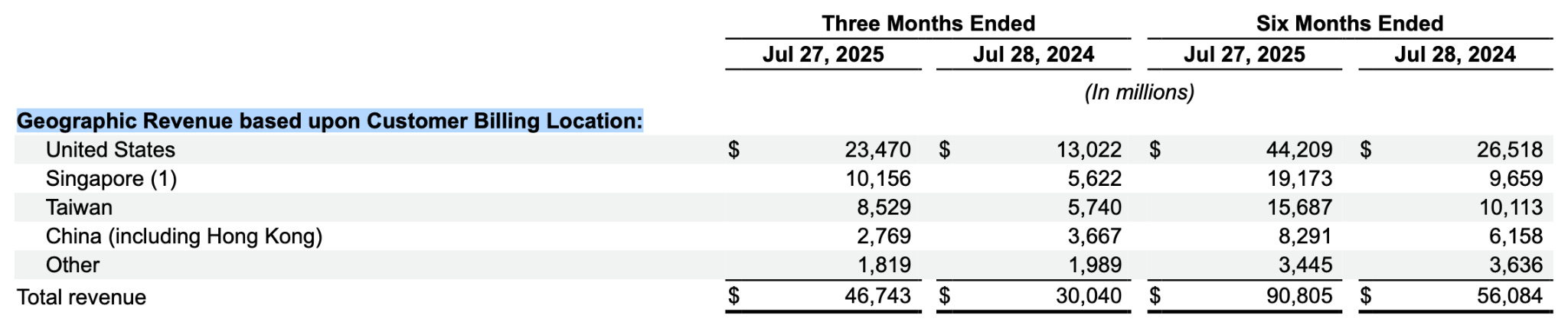
“(1) Singapore represented 20% of the first quarter of fiscal year 2026 total revenue based upon customer billing location. Customers use Singapore to centralize invoicing while our products are almost always shipped elsewhere.”

“(1) Previously, revenue by geographic area was reported based on the billing location of our customers, which often reflected a customer’s centralized invoicing location, even though our products were almost always shipped elsewhere. We believe changing to revenue based upon the location of our customers’ headquarters provides a better representation of the geographic profile of our revenue.”
“Billing location” has allowed huge volumes of potentially illegal orders from Southeast Asian buyers like Company-1 to be recorded as clean Singapore revenue, which is now booked as Taiwan revenue, and a good chunk of that might be China revenue.
It is highly suspicious that Nvidia switched to “customer headquarters location” five months before the Super Micro smuggling went public.
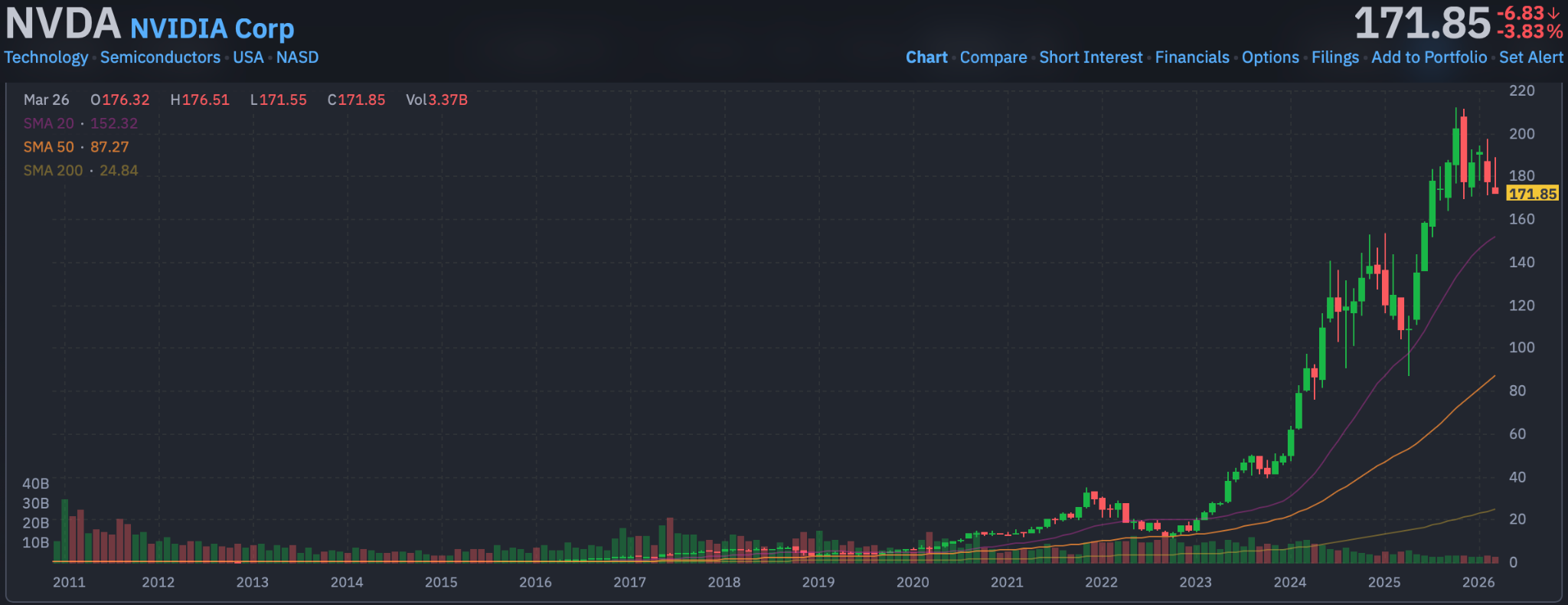
More than that, Nvidia is the most valuable company in the world with a $4.2 trillion market cap, selling arguably the most important technology of all time to China.
In January 2026, Anthropic CEO Dario Amodei said selling advanced chips to China is “a bit like selling nuclear weapons to North Korea.”
Government regulation poses a risk of limiting Nvidia’s ability to sell chips to China over the long run. This scenario doesn’t seem priced in at 35x trailing earnings. I’ve fully removed NVDA from my modified S&P.