
NEN, SGA

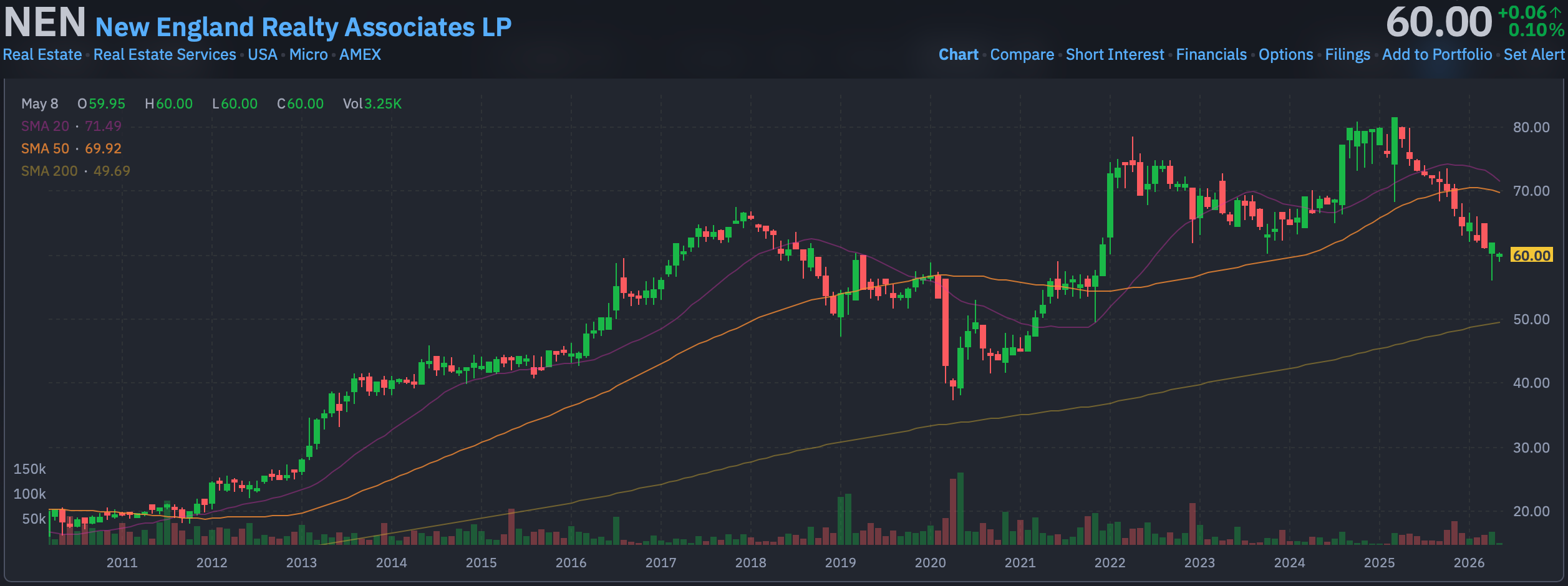
NEN has been flat over the past five years. Trailing NOI is about $55 mil. Market cap is $170 millio. Net debt is $570 million for an enterprise value of $740, implying a cap rate of 7.4%.
Cap rates for class B apartments in Boston are currently in the range of 5% to 6%. NEN trading at a 6% cap rate would put the stock at about $124. Shares currently trade for $60. Trailing 3-year average free cash flow is $16.7 million, a 10% yield on the equity.
It looks like there is a large margin of safety here. Plus, intrinsic value should grow at a nice pace over time. The stock has compounded at roughly 10% since 1988. The Brown family owns the majority of the company.
“NERA and its subsidiaries own 34 properties which include 22 residential buildings and properties; 6 mixed use residential, retail and office properties; 6 commercial properties, and individual units at one condominium complex. These properties totalled 3,339 apartment units, 19 condominium units and approximately 145,000 square feet of commercial space. Additionally, the Partnership also owns a 40-50% interest in 7 residential and mixed use properties consisting of 688 apartment units, 12,500 square feet of commercial space and a 50 car parking lot.
The properties are located in Eastern Massachusetts and Southern New Hampshire. As of February 1, 2026, the Partnership had 3,411 apartment units, including an apartment complex totaling 72 units at Mill Street Heights. On January 28, 2026, the Partnership sold two commercial office buildings, located in Belmont, Massachusetts, totaling approximately 14,000 square feet, for the sale price of approximately $2,600,000, incurring a loss of approximately $400,000. As a result of this transaction, as of February 1, 2026, the Partnership owned approximately 141,000 square feet of commercial space.”
Link to properties -- thehamiltoncompany.com/community-search-list-view.aspx.
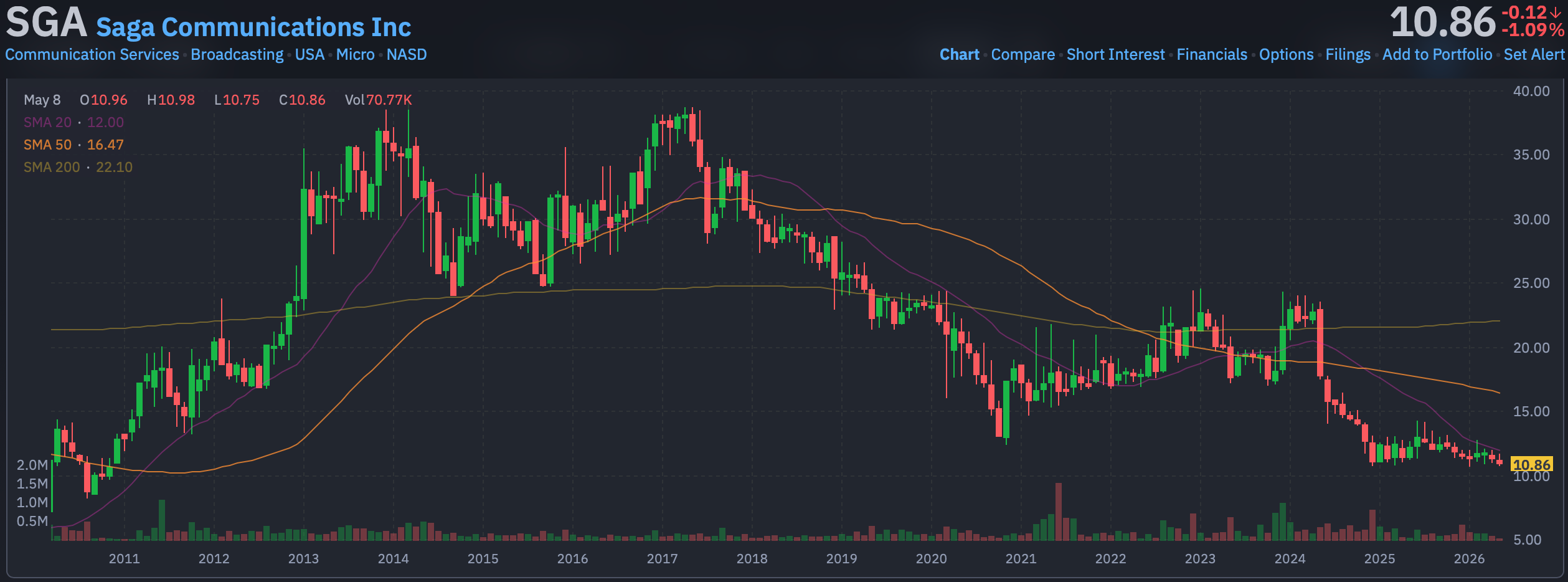
SGA is down 47% over the past five years. It’s a radio broadcaster that nobody wants. Market cap is $70 million. Cash on the balance sheet is $28 million versus $5 million of debt for an enterprise value of $47 million. The average three-year free cash flow is $7.8 million. Dividend yield is 9.1%.
In October 2025, Saga sold 22 tower sites to GTC Uno 22 sites for a $10.7 million cash purchase price ($486k per site). The gross historical cost removed from the balance sheet was $6.4 million. The company recognized an $11.6 million gain on the transaction due to the low net book value of the assets (after depreciation) and the value of the 25-year $1/year leasebacks, which added $4.4 million in non-cash consideration.
Net cash proceeds were $10 million. In December 2025, they repurchased $2.1 million of stock at $11.50 in a private transaction, representing 2.8% of Saga’s then-outstanding shares.
“We also continue to evaluate our non-productive assets with the intent of monetizing those assets at a value that is higher than is recognized in Saga’s stock price.” – CFO Sam Bash on their May 7th earnings call
Total gross assets are valued at $144.3 million: $13.5 million of land, $41.5 million of buildings, $21.6 million of towers and antennae, $56.7 million of equipment, $8.4 million of furniture, fixtures, leasehold improvements, and $2.7 million of vehicles, minus accumulated depreciation of $97.9 million gives a net property and equipment of $46.4 million. The books show depreciating assets, but in reality, land, buildings, and towers tend to appreciate over time.
Using the unadjusted $46.4 million net property and equipment figure, tangible book value is about $42.8 million. FCC licenses are valued at $90 million on the balance sheet; reducing that to $60 million gives a book value of $102.8 million, or about $16 per share. This conservative estimate of value is far above the present share price of $11.
In 2022, Saga rejected a $181.6 million to $199.8 million bid from Connoisseur Media ($30 per share). Gate City, which believes Saga is wasting dollars on its digital transformation, owns 13.6% of the company.