
LULU
Burry still likes it at 120

Burry posted earlier this week saying that LULU is hated like GME was in 2019, or something along those lines (post was deleted).
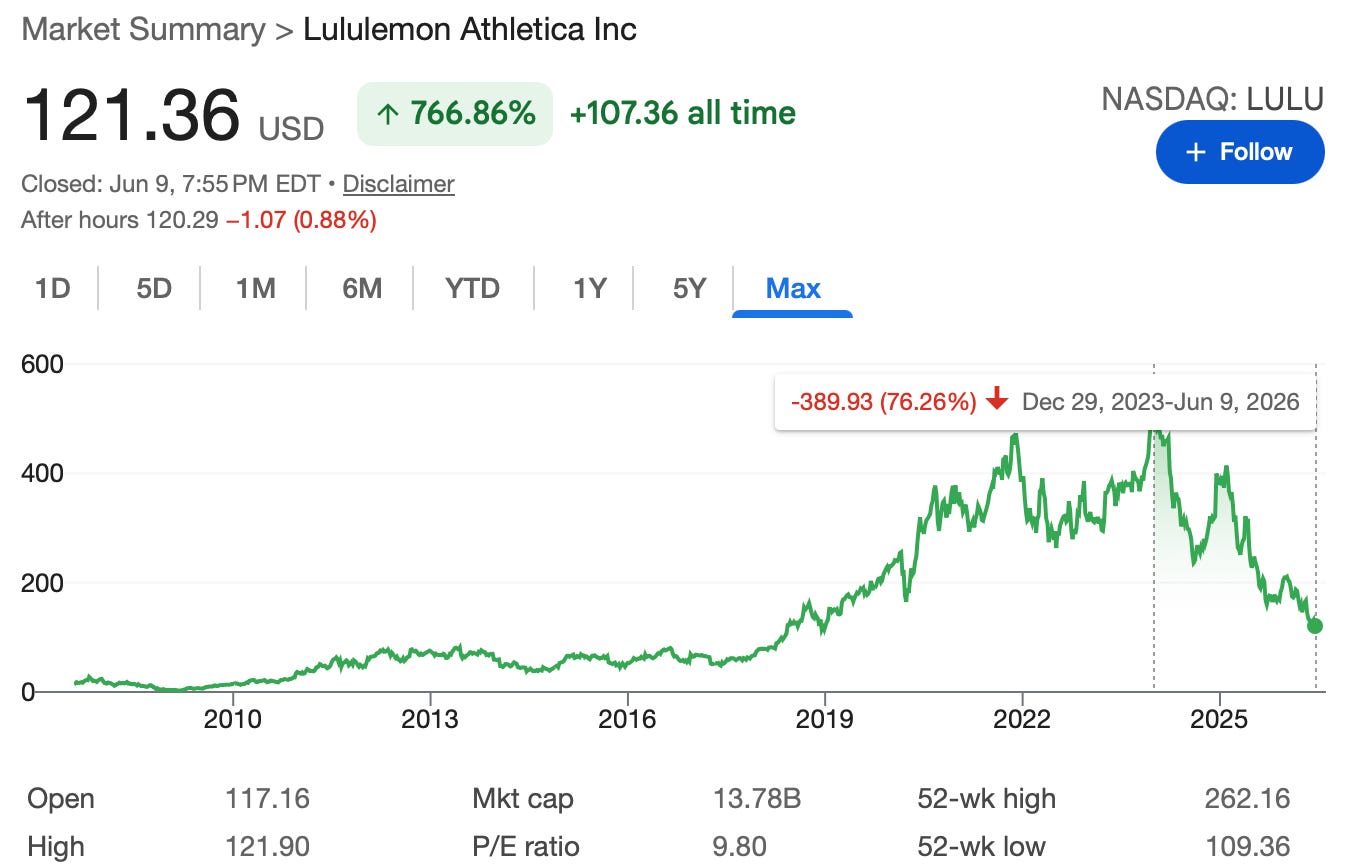
LULU has collapsed from its December 2023 peak of $511.3 to $121.4 today, a 72.3% free fall. That 9.8x P/E with the S&P 500 at 30x earnings has garnered some interest. I replied under Burry’s post and some dialogue followed:
“$LULU is trading at roughly a 12% FCF yield (three-year average free cash flow/EV), with very high returns on tangible equity, no debt, and extreme growth over the decade. Earnings per share have compounded at 20% since 2016.
The question is, can they do that again, or at least maintain their current position? Probably not. Apparel has low barriers to entry and exit. Consumer tastes change fast. I wrote this piece in Sept 2025 when the stock was at 167 --
Even with the shares now down 30%, I still think it is best to avoid. It’s not a Buffett-type investment, nor a Schloss. LULU has the makings of a value trap, in my opinion.
‘Thanks to those missteps, lululemon is losing its premium position to athletic brands like Alo and Vuori. Those retailers have followed Aritzia’s lead by opening beautiful, thoughtfully laid-out stores that could be someone’s living room, with wood and rugs and good lighting. Lululemon has none of that style and elegance anymore. It’s basically the Gap from 1998.’ -- Chip Wilson (Lulu founder)”
“was mid-april conversion cliff that derailed a q1 return to NAR growth a one time blip? or is the brand permanently impaired and the fixed cost deleverage about to snowball into negative fcf burn? the answer creates a binary set of NTM outcomes; a.) -30 to -40% vs b.) 100-300%”
“if they can just stand still — not grow, stand still—it can buy itself private in 9 years with orgsnic fcf if it can stsrt growing again…in india, EU, NAR. 6x-10x with accel buyback + multiple expansion that sounds very buffett to me”
“youtube.com/watch?v=rz9OT8 – I agree the historical numbers are great. Here is a video on Buffett and Munger talking about Nike. They didn’t like it and much preferred Coca-Cola. However, GEICO’s portfolio manager at the time, Lou Simpson, loved $NKE and owned it for a very long time. It was a profitable experience to say the least. Not so much anymore due to intense competition. $KO is still crushing. Also, in my view, Lulu has nowhere near the brand Nike ever had. With a narrow moat, there is no margin of safety at the current price. $LULU at around $70 is interesting.”
“curious, why $70?”
“That would give about a 20% free cash flow yield, so even if competition keeps eating them, I would probably get my principal back with a decent rate of return”
Coca-Cola (KO) has two mutually reinforcing pillars: an iconic brand and an unmatched global distribution system. They have one of the world’s most valuable brands, driving habitual consumption and strong retailer preference.
It has roughly a 40% share of the global non-alcoholic ready-to-drink (NARTD) beverage market and over 20% in soft drinks in many major countries, with about 2.2 billion servings sold daily across 200+ countries. They have huge scale and pricing power.
Products reach 33 million retail outlets worldwide via 225 independent bottling partners who finance and operate the vast majority of physical infrastructure (plants, fleets, warehouses, and direct-store-delivery).
The system includes 14 million units of cold-drink equipment (coolers/vending) and thousands of red trucks, creating near-ubiquitous availability.
Replicating this “last-mile” footprint would require decades and tens of billions in capital with low odds of displacing entrenched shelf space and contracts. Barriers to success are huge.
Coca-Cola’s asset-light model (concentrate business) delivers superior economics, with a 40% return on equity in 2025 while bottlers bear most infrastructure capex.
In the past year alone, the system added 600,000+ outlets and 340,000+ cold-drink units.
Lululemon on the other hand.
Low barriers to entry in apparel/athleisure: Unlike Coca-Cola’s massive capital-intensive distribution network that took a century to build, fashion and activewear have very low structural barriers. Designs, fabrics, and styles can be copied quickly and cheaply by competitors.
Vulnerable to fashion cycles: Demand is highly sensitive to trends, product innovation, and execution. High-quality substitutes (Alo and Vuori) and “dupes” spread quickly via social media, reducing customer loyalty. Recent slowdowns in North America, margin pressure, and the need for constant newness show how quickly the advantage can erode.
Limited pricing power: Increased competition has led to more promotions, slower growth, and gross margin compression – unlike Coca-Cola’s consistent ability to raise prices above inflation.
For these reasons, LULU at $120 (10x earnings) is not really attractive. Everything has a price range which offers a margin of safety, however, and LULU around 5-6x earnings may provide that.
Buffett bought Apple for 10x earnings. Coke for 15x earnings. See Candies for 12.5x earnings. Ultra-wide expanding moats at great prices.
Munger on Coke: https://fs.blog/turning-2-million-into-2-trillion/
I think this is a great take. A lot of people got anchored to the period of time when LULU was 40x earnings. 15x and 10x feel cheap when you think it's worth 40x, but that's classic value trap dynamic. Fact of the matter is LULU isn't the only player in the "leggings that make butts look good" industry anymore
One other competitor worth noting is Gymshark. Super cheap and decent quality available online only (aka low fixed cost business model) with super strong marketing via Instagram and influencers. Another example of how low the barriers to entry have become.