
Comcast
Stock is down about a third from its 52-week high. Growth has flattened, but it's buybacks and dividends galore. Trades at a 14.8% free cash flow yield.

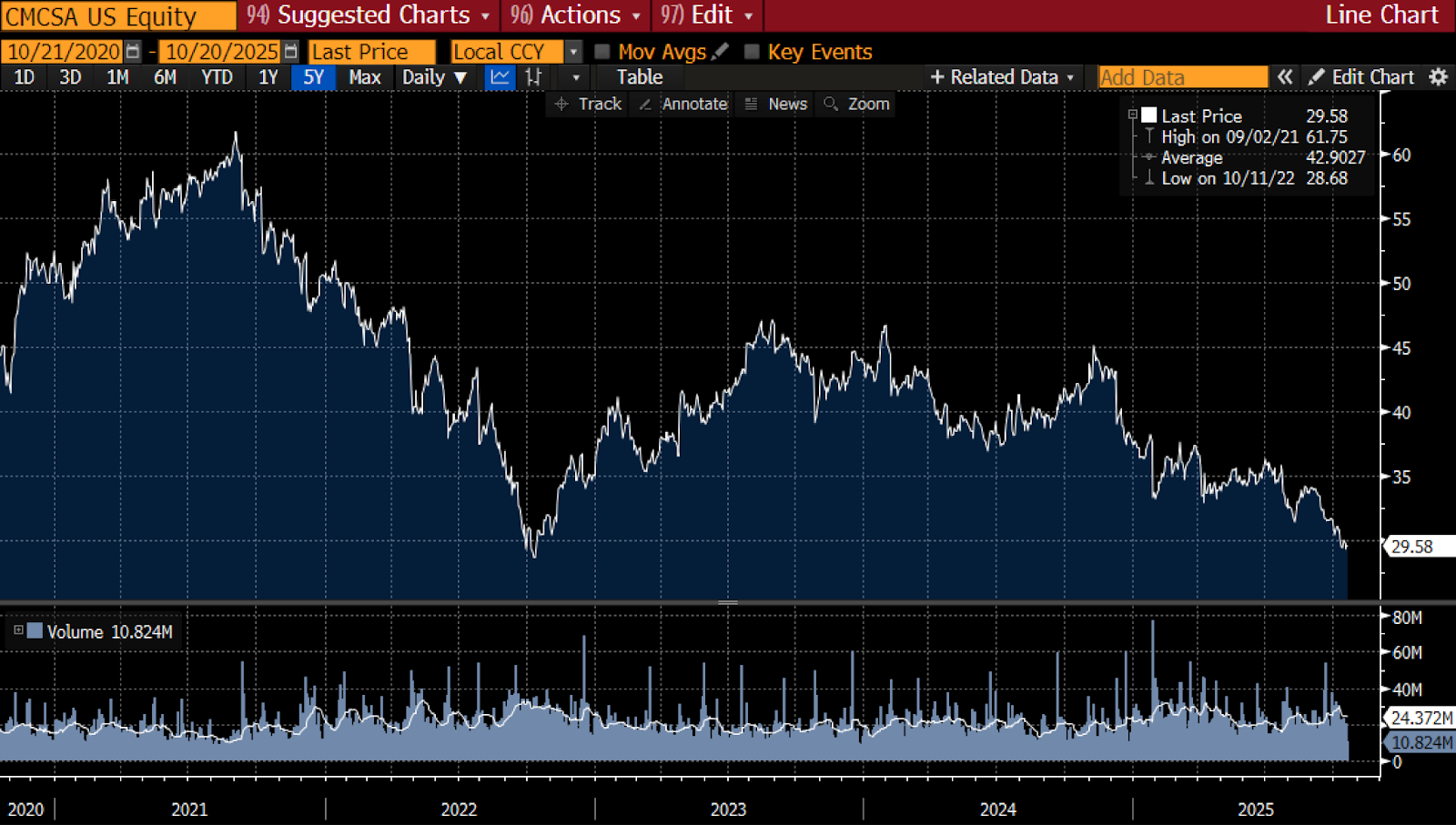
Comcast is a cable and media giant headquartered in Philly. It is the twenty-ninth largest company in the US by revenue, employs about 182,000 people, and has two main businesses: “Connectivity & Platforms”, which accounts for 62% of revenue and 82% of adjusted EBITDA, and the remaining comes from “Content & Experiences”.
Connectivity is Comcast’s golden goose with hundreds of thousands of miles of hybrid fiber optic and coaxial cable that serve thirty-two million Americans, making them the number one provider of “broadband” in the country. Broadband is modern cable internet that allows you to watch television, skim emails on your laptop, and doomscroll Instagram on your phone all at once in the comfort of your home. Going into the 21st century, virtually no households had this capability.
Dial-up was the main thing, and it was slow as molasses. The fastest speeds reached fifty-six kilobits per second. For instance, after seeing “You’ve got mail” on your screen, it might’ve taken roughly a dozen or more seconds to load the message. Today, it’s instant, at about twelve hundred kilobits, and according to Pew Research, eighty percent of U.S. adults paid for high-speed internet at home last year.
So roughly twelve percent of them subscribed to Comcast’s Xfinity, which currently charges $40 per month for a one-year – $480, or $55 per month for five years – $3,300. Xfinity is trying to lock in customers because nothing differentiates its product. Competition is legion with viable substitutes priced similarly, like Charter’s Spectrum and AT&T and Verizon’s wireless 5G, etc.
No doubt, Comcast’s connectivity moat has narrowed, and they’ve lost pricing power. From 2015 to 2020, subs grew from 23.3 million to 30.6 million, and EPS from $1.63 to $2.21, a 5.6% and 6.3% growth rate, respectively. Since then, subs haven’t budged, total connectivity revenue has flattened around $81 billion, and the stock has nearly halved. Some cord-cutters would say that such a price movement is valid.
I like to surf customer reviews, blogs, and X to get a feel for the qualitative aspects of a business — digital scuttlebutt, if you will. I found a 2,356-word essay published by “Chris” on February 2nd, 2024, under Xfinity’s “Billing” forum. Chris, a loyal customer for two decades, is ditching Xfinity because customer service is abhorrent, and paying hundreds of dollars annually for content easily found elsewhere makes no sense.
Most irritating to Chris, though, is that Xfinity won’t give him a discount after he’s paid them $30,000 over the course of two decades. “And if you aren’t willing to do that then I guess I will be getting a Roku, a Ring home security, and Ziply,” says Chris towards the end of his apoplectic rant, which is followed by a more rational statement, “Just do right by your customers and rethink your current business model. I am sure I am not the only 10 year plus customers that is just tired of having to have this same conversation over and over. Your loyal customers is what made Rodgers cable Comcast, and Comcast into Xfinity…”
On the bright side, Chris never complained that his Wifi went dark, and Comcast did rethink their current business model. They announced the spin-off of most of NBCUniversal, a dying cable network portfolio that now goes by “Versant” and will trade as “VSNT” by year's end. Funnily enough, odds are decent that Chris has forked out some dollars for a sub to Comcast’s streaming service “Peacock”, which now has 36 million subs and grew revenue last year by 44.1% to $4.9 billion.
And thanks to that hyper-growth, total media revenue increased 10.6% to $28.1 billion. Theme park and studio revenues dragged by about three percent and four percent to $8.6 billion and $11.1 billion, however. In total, Comcast’s top-line bumped 1.8% to $123.7 billion. Boooooriiiingggg.
Not if you like free cash flow, though. Comcast produced $16.3 billion of it last year and repurchased $11.3 billion of stock and paid $4.8 billion of dividends. That’s the norm, too. 2021, 2022, and 2023 saw buybacks of $4.7 billion, $13.3 billion, and $11.3 billion, and dividends of $4.5 billion, $4.7 billion, and $4.8 billion.
“We’ve been shrinking our share count by mid-single digits on an annual basis for the past several years, and we expect to continue to do that as part of a robust and balanced capital allocation framework.” said CFO Jason Armstrong during Comcast’s Q2 earnings call in July.
Finally, net debt to EBITDA is 2.64x, operating income to interest expense is 5.28x, and they also have $9.7 billion of cash on the balance sheet. CMCSA’s trailing free cash flow yield is 14.8% on today’s market cap of about $110 billion. Dividend yield is 4.4% and the weighted average interest rate on their $101.5 billion of debt is 4.1%.
Excellent write up. Modern World also did a great analysis as well. Regarding, $WBD, I remember when they took a run at Disney.
I do think Universal Studios could suffer in a downturn, but long term I think the addition of Nintendo World will have a positive impact to an audience and crowd of younger generations. Disney seems to be squandering their brand and relevance in recent years
Anyway, I also think the stock is cheap.
Agree. I did a little write up of my own a few weeks ago. CMCSA is down 10% since I wrote it on the heels of the Paramount/Warner news.