
CFND. LUMN. BRBR.

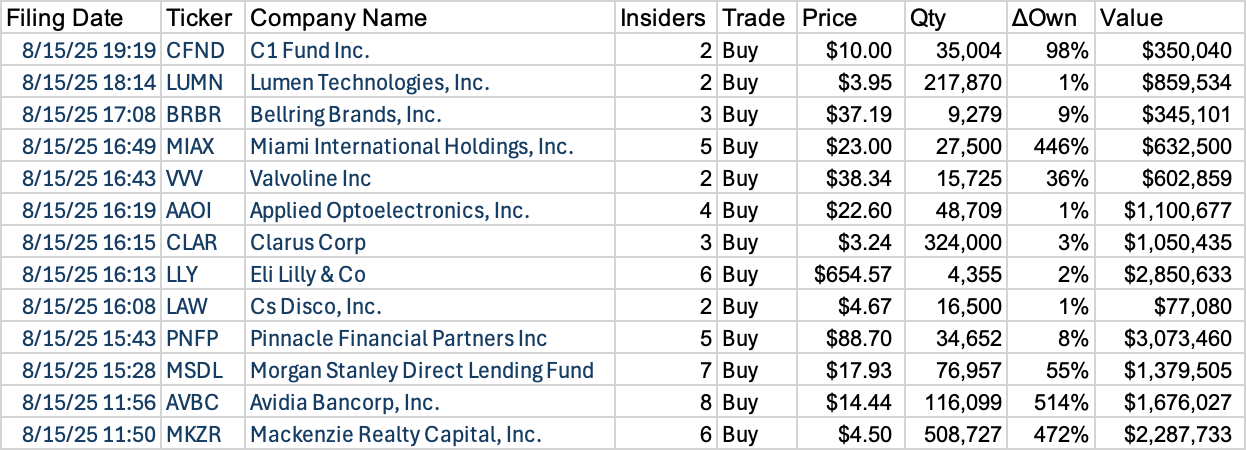
Listed above are the cluster buys from last Friday, filed post market. Loosely defined, a cluster buy is a purchase from multiple insiders on the same day or over consecutive days. Insiders include executives (CEOs, CFOs, COOs, etc.), directors, and shareholders owning at least 10% of stock. Below are journal entries on a few.
Aaaaaaand it’s gone.
The C1 Fund Inc. (CFND) raised $60 million of gross proceeds last week and will spread that money across no more than thirty late-stage, private companies focused on digital assets. C1 Advisors, C1 Fund’s investment adviser that’s owned by the fund’s management team through the C1 Group, puts together the portfolio and charges a 2.5% management fee on net assets. Now tack on another two hundred and fifty basis points for general overhead, and shareholders are paying 5% in total fees. They’ve also named the list of carefully curated crypto picks the “C1 thirty,” and I’ve a feeling this fund will fall harder than the nifty fifty or the soon-to-be-popped magnificent seven.
But that’s irrelevant for Dr. Najamul Hasan Kidwai, Michael (Xu) Zhao, and Michael Lempres, who are paid handsomely to democratize the privately owned digital landscape. Or put another way, getting uber rich to YOLO millions of dollars into things like Chainalysis, Fireblocks, Paxos, Anchorage Digital, Dapper Labs and Ripper Labs. These new school names, intellectually soothing stories and the brilliant minds behind them are irresistible to retail HODLers. And sometimes these euphorias burst into massive IPOs. Prime examples of this are Circle (CRCL), which makes stablecoins pegged to the dollar and Bullish (BLSH), an institutional grade crypto exchange that makes no money. C1 Fund’s job is to find the next one of the sort.
Also, while typing about publicly traded private funds, I would be remiss not to mention Cathie Wood’s interval fund – ARK Venture Fund (ARKXV). Unlike CFND, which trades daily on a public exchange, ARKXV trades quarterly with a 5% redemption cap. So it’s open to the public, but not publicly “traded” and $500 is the minimum investment. SpaceX, x.AI, and Neuralink account for about a quarter of the fund. Those daring positions are also marked by Ms. Wood, who has stamped a $2,600 price target on TSLA for a near $10 trillion valuation. That’s roughly half of the United States’ gross domestic product.
Non-sensical, but anything is possible. Just look at Palantir. The stock trades at 122.16x trailing revenue and a mushroomed $420.13 billion market cap. This is nutty considering that nobody really understands what they do. Not even employees:
“The problem, however, is that even ex-employees struggle to provide a clear description of the company. “It's really hard to explain what Palantir works on or what it does,” says Linda Xia, who was an engineer at Palantir from 2022 to 2024. “Even as someone who worked there, it's hard to figure out, how do you give a cohesive explanation?”
Humans adore complexity, and at times we’re suckers for eccentricity as well. Palantir’s CEO Alex Karp is proof of that. Karp is whacky and weird and has posed his will on Wall Street. The fifty-seven-year-old looks like he’s been struck by lightning. He has gray, frizzily electrified hair and can’t sit still. His mannerisms are goofy, his words are passionate, and his comments are way, way, way out there. He’s a high-strung cat, a sick puppy if you will. Earlier this year, he said
“I love the idea of getting a drone and having light fentanyl-laced urine spraying on analysts that tried to screw us”.
Karp didn’t like the idea. He loved it. Light fentanyl-laced urine? A bizarre, somewhat psychotic rebuke. He said “light” fentanyl too. So maybe not a fatal dose, but just enough to cause some damage. Anyhow, enough Karp. The point is that we're in a manic bubble and I view the aforementioned securities as dynamite. It’s best to keep your distance. Don't go long, nor short because markets can remain irrational longer than you can endure getting sprayed with fentanyl-laced urine by a drone.
LUMNineers
Lumen Technologies (LUMN), formerly CenturyLink, is the third-largest telephone company in the United States. It provides products and services through four brands: Lumen (cloud connectivity), Quantum Fiber (broadband), CenturyLink (legacy copper) and Black Lotus Labs (cybersecurity intelligence arm). On May 21, LUMN sold its “mass markets” business to AT&T for $5.75 billion. This dying segment of their business amounted to 21% of their revenues, and the sale provided some breathing room against a $17.1 billion debt burden. LUMN is pulling out of its legacy consumer business and plunging into AI. They’ve secured $9 billion of AI-related deals with Google, Amazon, Microsoft, and Meta.
Despite these positive developments, the stock remains in the dog house. LUMN is down a tad over 20% year-to-date after a near 20% pop upward last week. Management guides to a 2025 free cash flow of $700 million to $900 million, taking the midpoint, which is a 15.4% yield on the equity. Pretty juicy stuff considering material debt maturities don’t surface til 2029. Plus, CFO Christopher Stansbury and CEO Kathleen Johnson scooped up 82,000 shares at $4.36 and 135,870 shares at $3.69. Stansbury must’ve slept in or something. Anyway, the last time this duo purchased shares on the open market, the stock multibagged. LUMN’s worthy of deeper analysis.
BRBR
BRotein
Obesity is “a disorder that involves having too much body fat, usually a body mass index — also known as BMI — of 30 or greater”. To put that into context, a five-foot-eight, 215-pound person has a BMI of 30.8. That’s pretty much the norm these days. Here’s the stats:
1960 – 1962: 13% of adults were obese.
1971 – 1974: 14.5% of adults were obese.
1988 – 1994: 22.5% of adults were obese.
1999 – 2000: 30.5% of adults were obese.
2009 – 2010: 35.7% of adults were obese.
2017 – 2018: 42.4% of adults were obese.
2021 – 2023: 40% of adults were obese.
Look at that 2.4% percent dip. There's hope. And it can certainly be attributed to the millions of Americans stabbing themselves in the belly or thigh with a glugacon-like petite 1 filled needle. Does this mark the end of obesity? My gut tells me no. The majority of belly jabbers can’t take the pain and quit after three months of use. Further, consumer spending and health care are the backbones of our economy. Stripping obesity out of this country would throw us into recession, if not depression, and would curb any of the happiness mass weight loss would bring. Dystopian, but also hilarious if you zoom out a bit.
Another way to combat fat is protein. It tastes good, there are no side effects (besides some flatulence), and it can also trigger the release of GLP-1. Gym bros and gals have known this, but the huskier population has just discovered the pros.
“The 2025 IFIC Food & Health Survey shows that a whopping 71% of Americans are trying to consume protein—a steady climb from 67% in 2023 and 59% in 2022. And a “high protein diet” ranks as the most followed eating pattern for the third straight year. Protein is riding a wave of popularity, powered by trends in weight management, fitness and healthy aging,” said Wendy Reinhardt Kapsak, MS, RDN, IFIC President & CEO. “Our data show it is the most sought-after nutrient, the most followed eating pattern, and the top characteristic consumers use to define a ‘healthy’ food. When one nutrient wears all three crowns, it is not only time to take notice, but time to ask better questions and dig deeper.”
Okay here goes one. Might this be a fad or a forever thing? I don’t know, considering it’s a viable alternative to the needle, it could stick around. So I’m not sure, but I can share a stock that has benefited from America’s newfound proclivity to protein. BellRing Brands is a holding company of consumer nutrition and supplement brands that spun off from Post Holdings in the spring of 22. Products include protein shakes, protein powders, nutrition bars and nutritional supplements. Brands are Premier Protein (85.4% of sales), Dymatize (12.2%), and “other” (2.2%).
Their flagship product is the ready-to-go premier protein shake. It’s gluten and soy-free, low in sugar, loaded with vitamins and minerals, and packed with thirty grams of protein. The average American digests around seventy grams of protein a day, so guzzling one of these gets you nearly half there. Calories are also super duper low at 130 grams without sacrificing flavor. These drips of protein are pricey though. Amazon lists a twelve-pack at $26.39 or $2.20 per serving, and 1.53 pounds of powder costs $25.19 or $1.48 per serving. Moreover, Premier just barely undercuts Pure Protein’s pricing and leaps way beyond Pepsi Co’s Muscle Milk.
So BRBR, Got Moat? By definition, yes. The company earned a 43.9% return on capital last year and free cash flow was $197.8 million. They also bought back $146.6 million of stock. Profits are abundant, the share count is dwindling, and their topline has accelerated at an 18.49% clip since 2018. Beautiful numbers, but last week was ugly. BRBR released earnings and Wall Street released pure havoc on the stock, whacking it for a third of its market cap. Now that might’ve been an overreaction. Net sales were up 6.2% and they repurchased $83 million of stock at an average price of $65.07. The stock currently trades at 17.5x trailing free cash flow per share, and insiders are buying after a three-year-or-so hiatus from the stock.
Here’s a link to another two from Friday —