
Carvana
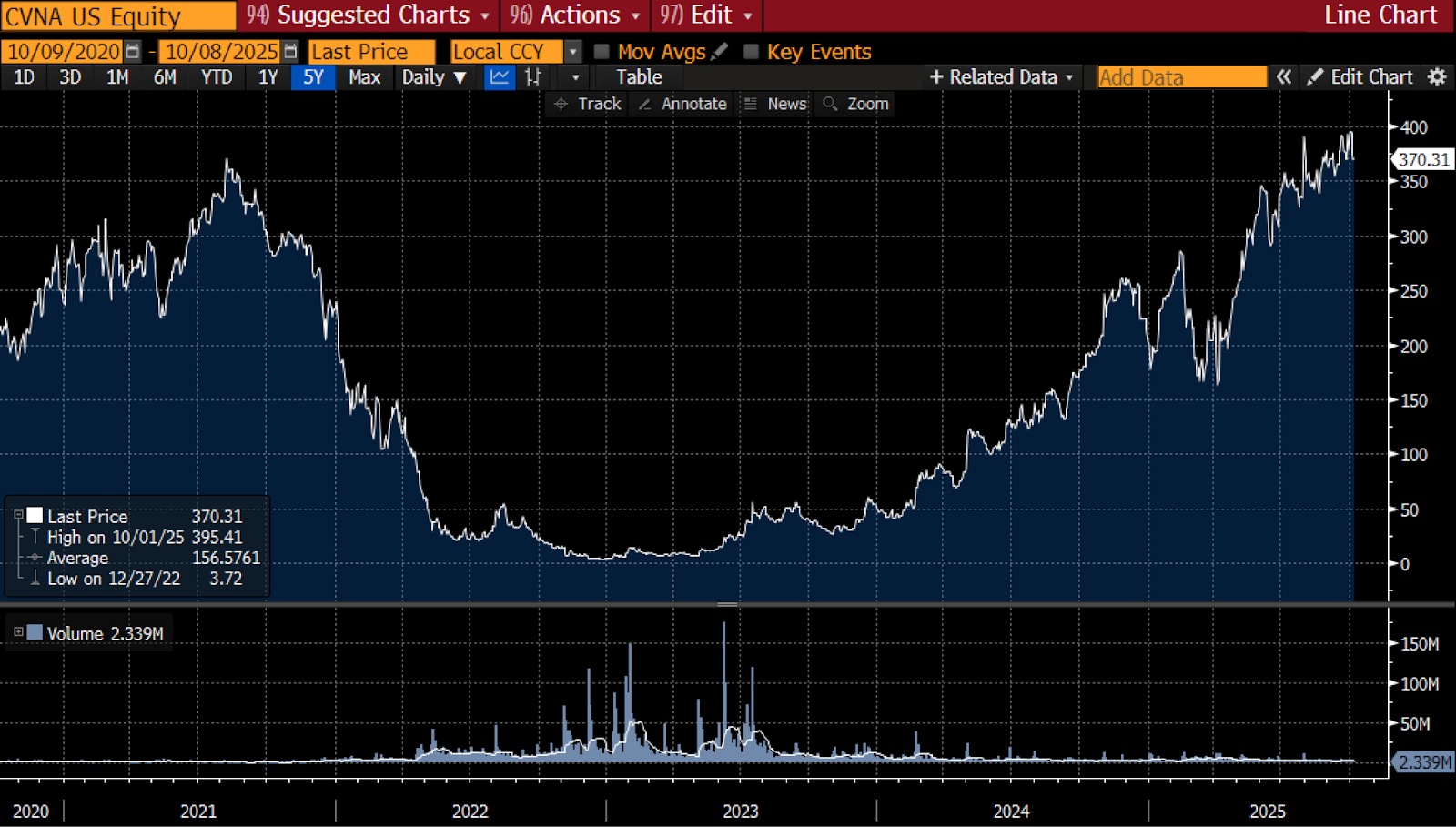
Stock is up about 80% since Hindenburg's short report in January. CVNA was subpoenaed by the SEC in June. Trades at lofty multiples of manipulated earnings.

“To our valued shareholders, 20 years ago on a hot day in Palo Alto, several future members of the Carvana team sat impatiently fidgeting during our college commencement address. We didn’t realize it then, but that commencement speech by Steve Jobs would end up being considered one of the greatest commencement speeches of all time. Speaking for myself, I completely failed to appreciate how much wisdom he shared with us when he said: “You can’t connect the dots looking forward; you can only connect them looking backwards.” Of all the dots we can connect from that speech with the benefit of hindsight, I think the most important might be what he ended with: ‘Stay hungry. Stay foolish.’”
Writes CEO Ernie Garcia III in Carvana’s 2024 annual report. Inspiring stuff, but Garcia took Jobs’ words terribly out of proportion. He’s staying greedy and stupid, suffocating subprime borrowers and parading maladjusted financials as true profitability, all while the SEC breathes down his neck. But this is learned behavior from his fraudulent father, Earnie Sr., who’s dumped billions of dollars worth of CVNA and counting.
From 1988 to 1989, a thirty-three-year-old Garcia II acted as a “straw borrower” in transactions designed to cover up Lincoln Savings & Loan’s ownership of speculative, Arizona desert land from regulators. Westcon Properties, a partnership that was controlled by Garcia, took out a $30 million line of credit from Lincoln. Then, Westcon turned around and used a portion of the funds to purchase land at an inflated price from “Amcor” – a subsidiary of Lincoln.
It was supposed to appear as an “arms-length” transaction, but regulators soon caught on. Some of the tells were: timing of payments, land valuation, and Garcia’s inability to repay the line of credit, as he spent about $20 million for personal use. Ding ding! On October 30, 1990, Garcia pleaded guilty to a felony bank fraud charge in U.S District Court in Phoenix and faced up to five years in prison, a quarter million dollar fine, and some restitution.
Of course, he ratted instead and received three years of probation and a fifty-dollar fine. Like most cons, Garcia’s entrepreneurial spirit was never squandered. Shortly after his day in court, Garcia bought a bankrupt rent-a-car franchise called “Ugly Duckling” which quickly foundered. But Ernie got creative: he merged the company with a financing business and revived the operation.
Subprime auto lending was booming, too, and Ugly Duckling went public in 1996 under the ticker “UGLY”, raising $170 million at $6.75 per share. UGLY enjoyed exciting growth, and the stock was a beauty, soaring for nearly a fourfold gain within a year. Fundamentals were fleeting, however, and mania wasn’t long for the market. UGLY shriveled, and so did hundreds of other empty sack stocks across the US. And with shares trading in the high 2’s, Garcia decided to take UGLY private, which, naturally, landed him in court.
Shareholders sued Garcia for an unfair going-private transaction, which grossly undervalued the company, and also for self-dealing in real estate deals, stating that Garcia abused his position to buy seventeen company-owned properties at a 10% discount through a related-party transaction. (Gee, that sounds familiar.) Garcia was acquitted, but about two decades later and with twenty-something billion dollars next to his name, he’s under the gun again, and so is his son.
A group of investors, led by the United Association National Pension Fund, is suing Garcia I and II and other Carvana executives for carrying out a pump-and-dump scheme. Hindenburg Research published a short report on CVNA in January of this year titled “A Father-Son Accounting Grift For The Ages” which included many details from the ongoing case. These two stick out:
“One allegation is that Carvana entered into a ‘sham related-party deal’ with DriveTime as early as 2021. [Pg. 43] As part of the alleged sham, Carvana paid DriveTime for vehicles it would sell and then remit the proceeds back to DriveTime for no economic benefit, as a means to artificially boost reported sales. [Pg. 43] Quantifying the impact of these alleged sham transactions, the deals reportedly made up 19% of Carvana’s Q3 2021 unit sales growth and 169% of Carvana’s Q4 2021 unit sales growth, its number one growth metric. [Pg. 44 & Pg. 26]”
“The Chairman of Carvana’s audit committee, Ira Platt, also has long-standing links to the Garcia family. Platt acted as a banker for DriveTime (then called Ugly Duckling) stretching as far back as 1998, per SEC records. He is named on stock pledge agreements, loan agreements, and bond placements, among others.”
Over the past fourteen months, Mr. Platt, Garcia’s old-time buddy, has sold $16.8 million worth of CVNA shares. Loyalty pays! For now, at least. Hindenburg goes on to highlight CVNA’s “litany” of accounting shenanigans. Here’s one:
“Normally, a business that originates and sells high-risk loans will “de-risk” its own balance sheet as soon as it can after loan origination. As described above, Carvana records no loss provisions and books the “gain on loan sales” when they are sold. A business like this looking to manipulate earnings could easily delay selling loans and warehouse them on its balance sheet at the end of a quarter if it wanted to pump up future quarterly earnings. This sort of behavior is commonly referred to as “cookie jar accounting”.
And the Garcias are cookie monsters:
“While decelerated loan sales led to negative adjusted EBITDA for Q1 2023, the Garcias took the opportunity on July 17th to sign an agreement to purchase $126 million in stock, eventually paying ~$37 per share. Two days later, Carvana announced the “best quarter in company history,” including the successful restructuring of its debt and positive adjusted EBITDA driven by re-accelerated loan sales, fueling its ‘comeback’ and sending the stock soaring to ~$57 intraday, per FactSet.”
In essence, Carvana is run by a father-son duo with no scruples that rely on a thriving securitization market for profits. Subprime auto delinquency rates are also nearing highs, and CVNA’s accrued PIK interest is snowballing, so it’s fair to say the worst lies ahead. Plus, CVNA has $4.5 billion of borrowings with $559 million, $1.7 billion, $2.1 billion coming due in 2028, 2030, and 2031, respectively. Considering the SEC subpoenaed CVNA in June, I think there’s a higher chance they’ll get pinched than pay off their creditors. Shorting shares should do well.
More than just any debt burden, their enterprise value suggests a capacity to generate many billions of dollars of free cash flow from operations. This capacity simply does not exist.
Great article - I was surprised to hear that you are looking for a job (from your last article). Your writing is better than many other (employed) analysts put there.